Category Archives: Uncategorized

Bax and Bartók: A Question of Influence

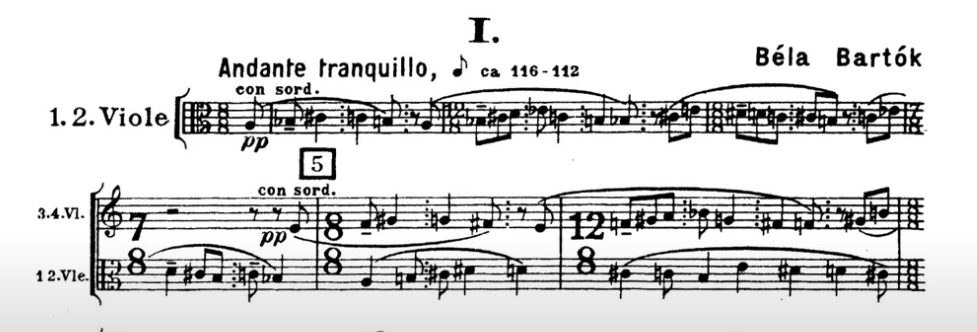
Béla Bartók’s Music for Strings, Percussion and Celesta was composed in the summer of 1936, and is widely regarded as a masterpiece of his mature period. Less well known, however, is a similarity between its opening fugue and the first movement of Arnold Bax’s third symphony, composed in 1928-9.

The similarity is easy to spot by ear. Bartók’s fugue begins with a subject whose opening phrase outlines a distinctive shape of A, B flat, C sharp. Bax’s symphony begins with a winding bassoon theme on the exact same pitches. While the Bax is less strictly fugal, the clarinet and flute do join in with imitative entries, and both movements go on to make obsessive use of the three-note shape.

A few commentators on internet forums have noticed this connection, but otherwise I can find no writing on it. So I decided to investigate the obvious question: could Bax’s symphony have influenced Bartók’s MSPC?

I say ‘influenced’, because there is no question of plagiarism here. Despite the striking similarity at their starting points, these two works go in very different directions, each distinctive to their composers. But the possibility remains that the Bax might have planted a seed in Bartók’s mind – a conscious or unconscious seed – that later grew into the MSPC fugue.

For the last few days I’ve been looking at newspaper archives, and every relevant biography in London’s libraries. It seems almost certain that Bartók knew about this symphony’s existence, at the very least. The question of influence is therefore a legitimate one, even if it is impossible to answer definitively.

Bax and Bartók were almost exact contemporaries, born two years apart. And as his statue in South Kensington attests, the great Hungarian made many trips to London to give concerts. He also went to Liverpool, Glasgow and Birmingham. Several of these British engagements occurred in the crucial years between these two works appearing, 1930-6.

At some point it seems Bartók was studying Bax piano pieces with a view to performing them. This was relayed to me some years ago by the Bax scholar Graham Parlett. He has sadly since passed away, and I’ve been unable to track down the newspaper source of this. Nonetheless, more anecdotal information comes from the memoir of Harriet Cohen, Bax’s long-term lover and musical collaborator, to whom Bartók later dedicated part of his Mikrokosmos. She wrote that Bartók ‘much admired’ Bax’s 1922 piano quartet.

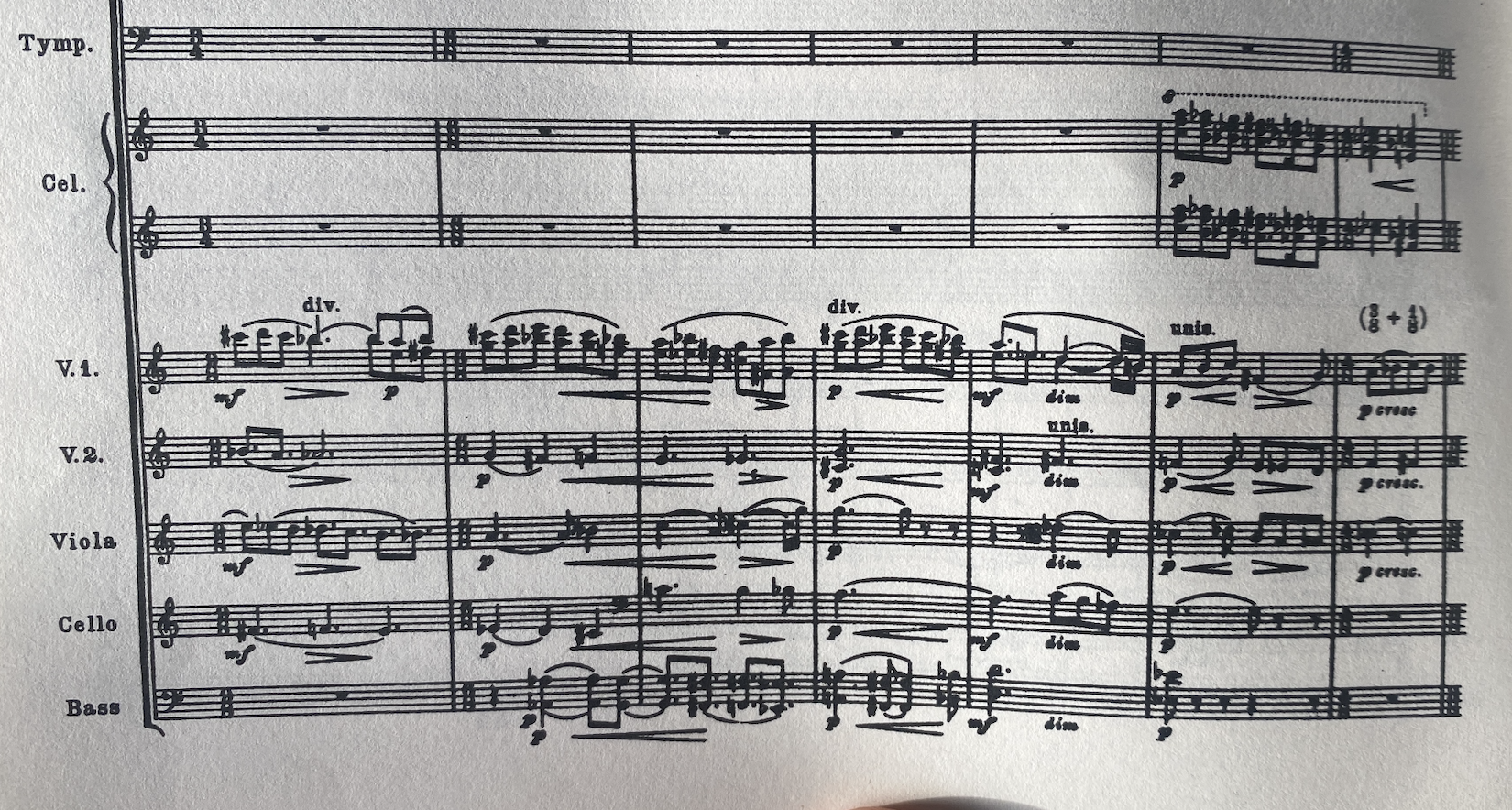
So Bartók had at least a passing interest in Bax’s work. What’s more, the thematic similarity between the two movements is bolstered in a later passage of the Bax, in which he repeats the introduction in the strings. The violas start things off, just as they do in MSPC – in the Naxos/Lloyd-Jones recording, it comes at 12:53. Now look at what happens next…

…that’s right, the celesta joins in (and continues over the page). If anything could have influenced MSPC, it’s surely these bars. The celesta makes another prominent contribution when the symphony’s opening theme returns in the third movement’s ‘epilogue’.

How likely is it, then, that Bartók knew this work? Admittedly, I haven’t been able to find a performance of the symphony that coincided with his UK visits. But he almost certainly heard about it through his engagements with Henry Wood, the symphony’s dedicatee who tirelessly championed it throughout the 30s. After giving its premiere in March 1930 to significant press interest, Wood conducted the symphony in every Proms season from 1930-4 (imagine such support for a large-scale new work today!), and took it to Zurich, Rome, and Los Angeles. ‘We are very proud of him’, he later wrote of Bax, adding that the third was ‘perhaps my favourite’ of his scores.

Beecham and Barbirolli conducted performances of it in these years too. Most tantalisingly, several newspapers reported that Adrian Boult was going to include it alongside Bartók’s Four Orchestral Pieces at a BBCSO concert in Budapest in April 1936. What a perfect smoking gun for influence that would have been! But in the end it seems they performed Tintagel instead.

Others may have drawn Bartók’s attention to the work. Harriet Cohen fondly recalled long conversations with him in Strasbourg in 1933, where she was to perform Vaughan Williams’s piano concerto, from which the composer had recently decided to cut a quotation of the symphony’s epilogue. The following year, Bartók’s friend Joseph Szigeti performed the Mendelssohn violin concerto in the same Prom that the symphony featured in.

Arguably, we could go far as to say that, given Bartók’s British connections at the time when this symphony’s fortunes were riding high, it’s possible he felt this was a piece he ought to know. The score was published in 1931, so he could well have got his hands on a copy. And while the first recording was not made until 1944, he might have heard a radio broadcast.

But of course, this is all speculative. Influence cannot be proven, and in one sense, it doesn’t matter, since there’s no real question of plagiarism, and the similarities may be coincidental. But as someone who adores Bax’s beguilingly beautiful but long-neglected symphony, it is disappointing to see that not one of the Bartók books I’ve been able to get my hands on make a single mention of Bax at all – not even Malcolm Gillies’s Bartók in Britain. 

Digging into this question has convinced me that Bartók scholars should at least recognise the possibility of influence here. After all, the past does not respect our modern prejudices: Britain may have long since abandoned concert performances of Bax’s symphonies, but the third was considered an important new work in the 1930s. It got an enviable amount of attention, so much so that in 1932 William Walton could hope that his own symphony would ‘knock Bax off the map’. If Bartók encountered Bax’s symphony in any form during his visits here, he would have approached it with that understanding too.

My blog posts are powered by caffeine. You can support Corymbus by buying me a coffee on PayPal, or subscribing to my Patreon.

Earth, Sea, Air

Screenshot 2024-07-24 at 08.22.17

© David Shepherd

On Friday, a cello concerto by Cheryl Frances-Hoad, ‘Earth, Sea, Air’, will be performed at the BBC Proms. Cellist Laura van der Heijden and the BBC Scottish Symphony Orchestra will reprise the piece that they premiered in Glasgow in 2023 under the baton of Ryan Wigglesworth.

The concerto is sandwiched between works by Britten and Elgar – two composers with connections to English regional landscapes. As its title suggests, nature is a key theme in this concerto, but its influence is more particular than at first appears. Cheryl’s own comprehensive note about the work – combining facts about swifts, phytoplankton and volcanoes – reads a bit like a script to a David Attenborough documentary. I offered to interview Cheryl to find out more about her approach to writing about the natural world. 

She’s recently moved to the countryside near Cambridge, and at various points in our Zoom call, I could hear a bird loudly singing through her window. I asked her if it’s the peculiarities of nature, the individual species, that intrigue her the most in her work, rather than general notions of landscapes.

‘You know, I’ve never thought about it, but that is very true. I haven’t written pieces inspired by…the view from the top of a hill, or something. It’s the specificity of it that inspires me. In a way makes it no different to the way I take inspiration from anything else’.

For this commission, Laura van der Heijden had suggested an environmental theme. But Cheryl was uncomfortable with the idea of composing in a preachy way. ‘I have a slight wariness of writing a big climate change piece…I mean what do I think it’s gonna do, people are gonna come to the Albert Hall and then stop using their cars? I mean of course not, right?’.

A Visiting Research Fellowship in the Creative Arts at Merton College, Oxford gave her an academic entry point to composing the piece. The position was an opportunity she almost didn’t apply for, but which she now talks about with relish. ‘It was just absolutely wonderful, it changed my life really. I made friends with all these academics who shared lots of their research with me, and I wrote pieces taking inspiration from what they told me.’ An 18th-century summer house in the Fellows’ garden was furnished with a piano for her use.

Over coffee, Professor Thomas Richards, a specialist in Evolutionary Genomics, told her about experiments to make oceanic phytoplankton ingest a greater proportion of the world’s CO2 emissions. The idea of colourful plankton blooms inspired her approach to the concerto’s slow movement, making her think about ‘how orchestral harmonies might grow, change and fall’.

The modern resurgence of British nature writing has played its part in the concerto too. Charles Foster’s 2021 book The Screaming Sky is about swifts: the sleek, ever–airborne migratory birds, a colony of which nest in the tower of Oxford’s Natural History Museum. ‘There were a couple of really beautiful sentences that made me think about line’ she says of his work, part of a growing publishing trend which now colonises entire tables in Waterstones. The cello part, in her mind, became a swift ‘flying over land, water, and through the air’. Meanwhile, dramatic photographs of volcanoes from Earth on Fire by Bernhard Edmaier added to her mental imagery for the composition.

Searing pyroclastic flows are mercifully unfamiliar to Southend, where Cheryl was born, and likewise the rural surroundings of ‘posh North Essex’ that she moved to as a child. She went on to study at the Yehudi Menuhin school in Surrey, and then Cambridge. Having never lived in a big city, I ask her if nature has been important to her for as long as she can remember.

‘It’s always been something that I return to, and I think it’ll become more and more a theme of my work, actually. It seems to be what I gravitate to most naturally’.

It has also helped her to win recognition. Her 2021 orchestral song-cycle Scenes from the Wild picked up an Ivor Novello Award in the Large Ensemble category. The 70-minute work is based on Dara McAnulty’s Diary of a Young Naturalist, a book which recounts how nature helped him through adolescence with autism. It won the Wainwright Prize for nature writing, garnering widespread praise along the way. 

Cheryl read about 30 books in search of a story for her commission, which was originally to be an opera. ‘It took a year to find it, it was Radio 4 book of the week. Within a week I’d decided to set it. It’s a wonderful book. He feels like there’s no barrier between him and the natural world.’ McAnulty attended its premiere in Glasgow, but despite winning the Novello, neither a second performance nor a recording is currently on the horizon – a frustrating situation that’s familiar to many composers.

It’s perhaps a sign of an environmentally-conscious generation of young musicians that another of Cheryl’s recent commissions has a nature theme. The pianist Annie Lim handed her a copy of Sue Stuart-Smith’s The Well-Gardened Mind, after discovering the benefits of gardening during a long Vancouver lockdown. Cheryl’s piece for Lim, Dance Suite, takes its inspiration from the book and is premiered at Presteigne Festival in August. 

But it’s upcoming opportunities to collaborate with scientists that seem to really excite the composer. Her face lights up when she speaks about composing a string quartet for the 25th anniversary of the Gregor Mendel Institute of Molecular Plant Biology in Vienna. She explains that a root won’t extend unless it senses gravity, so you can’t lay it on horizontally on a microscope slide and expect to see any action. ‘I really love this idea…and the way that makes you think. Rather than just representing it with a note gradually going down, you want to think about gravity, how does gravity work in harmony for instance, and I guess you might say pulling from one tonal centre to another is a form of gravity, right?’

Neither is that the end of her laboratory adventures. A commission for the pianist Charles Owen has taken her to the Oxford Physics Department. ‘I literally didn’t even do science GCSE, they let me skip it so I could practise more’, she marvels. ‘Suddenly I’m in the sub-2-level basement of this building where they do experiments, and it’s all underground to avoid vibrations. There’s three scientists who are slowing down atoms, they’re all patiently explaining this to me. I just find it very, very exciting, and the fact that composition has allowed me to do all this stuff. It’s a great honour and a privilege to have access to these people.’

While the Merton College fellowship has opened doors, she had previously spent a year as Composer in Residence at Cambridge’s Psychiatry department, observing a group investigating early-onset psychosis. ‘It was a leap of faith and a pragmatic desire to get money that led to all of this’, she tells me. ‘It’s just a sort of desperation to be able to survive as a composer’. This approach to work can make her feel ‘a bit like a market trader’, but it has allowed her to compose full time. ‘Remarkably’, she says, ‘it keeps not going wrong. I have a very cheap lifestyle.’

What’s clear is that Cheryl’s innate energy and curiosity allows her to engage artistically in a bewildering array of subjects, whatever opportunities might come her way.

‘Earth, Sea, Air’ will be performed on Friday 26th July at the BBC Proms. A recording is available from Chandos.

Sphinx Organization, Wigmore Hall

IMG_1348

At Wigmore Hall on Sunday, I went to a concert by Sphinx Organization, a Detroit-based non-profit who champion diversity in classical music. The concert featured chamber music by African-American composers, alongside our very own Samuel Coleridge-Taylor.

Samuel Coleridge-Taylor was, of course, named after the poet Samuel Taylor Coleridge. And in what much surely be a rare case of recursive naming, the composer Coleridge-Taylor Perkinson was named after him. Perkinson was born in in 1932, and died in 2004. And it was a work composed just before his death that stood out in this concert: his short and rather innocuously-named Movement for String Trio.

Coming after a quartet arrangement of Strayhorn and Ellington’s jazz standard Take the A Train, the solemn Bach-like counterpoint of the piece took me completely by surprise. Perkinson plays games with the rhythm, introducing an element of wonkiness which prevents it being Baroque pastiche. The result had something of that mysterious, simple effectiveness that is somehow able to leave a deeper impression than music of much greater ambition.

Listen here (youtube).

Read a review of the whole concert by Bernard Hughes on The Arts Desk.

Time’s Echo

By Peter Davison

At a time when classical music is losing its cultural significance, it is reassuring to read a book in high praise of major works by major composers, reminding us of a time when serious music was relevant to more than just an educated elite. The American musicologist and critic Jeremy Eichler’s recent publication, Time’s Echo, makes a convincing case that the wide appreciation of great music prevents collective amnesia, thus lessening the chance that humanity will repeat its most egregious errors. In our contemporary world, the re-emergence of authoritarianism and bitter ideological disputes feels like a regression to a former historical era. We can even perceive the slow decline of classical music as evidence of a more general wish to forget who we are, as political expediency and the banalities of celebrity culture obscure historical truth. A society that prefers fantasy over reality is surely in trouble.

Jeremy Eichler reminds us that classical music is vital to our sense of continuity with the past, as well as preserving the inherited values of our collective identity. He argues that the music of memorial, written by the likes of Schönberg, Richard Strauss, Britten and Shostakovich, can reawaken shared memory far more effectively than even the most imposing physical monument, because music exists outside of time and speaks directly to the human heart. But, without our active engagement, these works will surely disappear and take their memories with them. 

Eichler’s argument is convincing, not least because his prose possesses such fluency, precision and passion. The book is itself an act of memorialisation, even an act of cultural rescue. His research is meticulous, visiting locations associated with the composers and their works, delving also into their personal archives for original material to support his case. He discovers continued sensitivity around the reputations of these composers, as well as evidence of the personal and historical connections that existed between them. Read Eichler and suddenly classical music really matters again as a way of telling the human story with its search for universal truths in shared experiences. Can we then afford not to listen to this music, not to value it greatly, not to learn its timeless lessons?

Eichler begins his account with the controversial figure of Arnold Schönberg, whose 7-minute narrated work from 1947, A Survivor from Warsaw, was a surprising hit after its first performance in Albuquerque, New Mexico. The music presents the listener with a visceral depiction of antisemitic violence and cruelty. Yet we soon discover that Serge Koussevitsky, who had commissioned the work through his Foundation, was queasy about performing it, despite himself being a Jew. Meanwhile, in post-war West Germany, the authorities felt obliged to alter the text to reduce its impact.

Schönberg always presented himself as an artist in ‘world historic’ terms, a vessel of progress and, according to Eichler, as the personal axis of a power struggle between German and Jewish culture. The burdens of history were always tearing him to pieces. In his youth, Schönberg had been an ardent Pan-German nationalist, devotedly following Wagner and writing ambitious works in a ripe late-Romantic style. He even invented serialism to secure ‘the supremacy of German Music,’ words that would later haunt him after he embraced his Jewish identity in response to the antisemitic persecution which forced him into exile in the USA. 

His unfinished opera Moses und Aron (1932) sought a synthesis that could provide an answer to his crisis of identity. Moses represents the transcendent Word of God, which is incomprehensible to ordinary people for whom the divine message must be sugar-coated with lyrical sensuality. Moses lacks the knack for communication which Aron possesses, a shortcoming which acts upon him like a curse. The opera was never completed, in part because the work’s tension between intellect and feeling could not be resolved. To Schönberg, Judaism meant revering God as law, an abstract authoritarian presence, while German Romanticism increasingly represented to him a pagan world of love and longing. Although he claimed otherwise, the two sides of Schönberg’s character, heart and brain, were forever at war.

But did they have to be? Schönberg wanted to solve every problem with a once and for all solution, whether he was redrafting the timetable of the Berlin tram system or proposing the creation of a Unity Party to champion the cause of a Jewish homeland. His rigour took things to extremes. Eichler tells us that Schönberg sent his plan for a solution to the Jewish question to Thomas Mann for comment and received a lukewarm response. Mann warned him that his views might be perceived as ‘fascist’ in tone, even copying the antics of the Nazis. Schönberg had informed Mann that he himself intended to take charge of the party and would demand total obedience from its members. In truth, serialism was another product of his cerebral approach to communication, a way of exerting the intellect’s control over musical pitches. He had become Moses without Aron. Yet Eichler presents us with a sympathetic portrait of the defiant composer whose experiments with tonality had such a profound impact on music in the twentieth century.

Schönberg’s nemesis, we might imagine, would be the Bavarian composer, Richard Strauss, a thoroughly bourgeois character steeped in Wagner, who at first had supported the young Schönberg but came to consider him a madman. Strauss’s reputation has long been stained by his flirtations with the Nazi regime in the 1930s and for his egocentric Nietzschean outlook, which rejected religion and metaphysics in favour of  ‘superman’ individualism. Some commentators perceive a direct link between Nazi ideology and Nietzsche’s revolutionary anti-Christian polemic. 

But Strauss, like Nietzsche, could never quite rid himself of a longing for transcendence which was the hallmark of German Romanticism. Yes, Strauss was naïve, often shallow and smug, but he was not a monster, and he came to regret his contact with senior members of the Nazi party. Eichler focuses on Strauss’s late masterpiece Metamorphosen (1945), a virtuosic work written for twenty-three solo strings. With a series of powerful insights, Eichler encapsulates Strauss’s grief and need for contrition. In particular, he draws our attention to the quotation from the funeral march of Beethoven’s Eroica Symphony which Strauss tags In Memoriam towards the end of the score. Inevitably the question is asked, in memory of what? Eichler senses a deliberate ambiguity. Surely Strauss is not memorialising the fallen tyrant Adolf Hitler. Unlikely, since by this time, the regime had murdered his son’s mother-in-law and stripped Strauss of his official titles. But the beautiful and heroic dream of German Romanticism was certainly over, its cultural landmarks reduced to rubble. In Metamorphosen, Strauss remembers and regrets; remembers the idealism and visionary works of Beethoven, Wagner, Goethe et al, and regrets his own political naivety and capacity for superficial diversion. His music signals a painful confession. Eichler’s account of the work and Strauss’s state of mind is deeply moving, so that we can only feel sorrow and forgiveness towards the ageing composer. 

Eichler then turns to a later work, Benajmin Britten’s pacifist statement, the War Requiem of 1962. He cites and questions the often-quoted myth that Britten was the first British composer of any significance since Henry Purcell, but he does not provide the evidence fully to dismiss the idea. What of the generation of Elgar, Holst and Vaughan Williams? The latter’s Third Symphony is surely one of the most poignant of all elegies for the fallen of the First World War, while his Sixth is an appropriately bleak response to the Second. Elgar also gave poignant voice to collective grief in The Spirit of England (1917), a work which Britten greatly admired.

That said, Britten’s War Requiem uniquely attempts to bind modernity to the past, much like the new Coventry Cathedral for whose opening in May 1962 the piece was commissioned. The shell of a medieval church, bombed on a dark night in 1940, is juxtaposed with a concrete hangar of radical newness. The anima loci is not lost on Eichler, who describes both the new cathedral and Britten’s music as ‘a constant reminder of the thinness of civilisation’s veneer and of the human capacity for self-destruction.’ The War Requiem places the vivid religious theatre of grand Masses by Bach, Mozart, Beethoven, Berlioz and Verdi, alongside the subjective alienation of Wilfred Owen’s  poetry from the First World War. It is a work of heartfelt grief, offering both a critical assessment of war and emotional consolation for the dead and those they leave behind. The first performance was as a public occasion the last time a living British composer of classical music could claim to act as a voice for the whole nation. But the work was also an act of international reconciliation, and its reach was also fascinating. According to Eichler, Shostakovich loved the work, risking the wrath of his political masters who had refused permission for a Russian soloist to be present at the premiere to sing the soprano part.

The friendship between the two composers led Shostakovich to dedicate his 14th symphony to Britten, a work that dances with death and flirts with nihilism, as disturbing as it is finely wrought. This despair had followed the controversy of Shostakovich’s 13th Symphony ‘Baba Yar’, a setting of poetry by Yevgeny Yevtushenko which commemorated the 30,000 victims, mainly Jewish, of a notorious massacre in the outskirts of Kiev in 1941. Eichler tells us that the Soviet leader Khruschev lectured Shostakovich face to face, complaining that such negative emotions undermined the optimism of the State and its citizens in their pursuit of a socialist Utopia. 

Despite further intimidation of the performers by the regime, the premiere of the 13th Symphony went ahead, and audiences adored it. It touched a deep vein of unexpressed grief in the Russian soul. Shostakovich found himself under constant pressure to toe the official Soviet line, and it broke him physically and mentally. He was, like Thomas Mann’s protagonist in his novella Death in Venice, an artist torn between his need to be accepted by the Establishment and the personal torments that raged within. Such psychological conflicts are among the key messages of Eichler’s book. Artists of this stature are inevitably caught between the desire for the public accolades which flatter them and secure their livelihoods, and the call of their integrity that rebels against the fickle and shallow world of the governing classes; an elite eager to claim great art as an adornment to their vanity. Nobody endured political hypocrisy more than Shostakovich, and Eichler reminds us that, when he died, those who had condemned him most were first in the queue to accompany his coffin.

But Time’s Echo is primarily a book about how human societies grieve and remember grief, and the role that serious classical music plays in ensuring that we retain a relationship with the past and the dead upon whose shoulders we stand. For the Soviets, the horrific scale of sacrifice was not the issue. Their chief concern was to defend their country and political system, and the World Wars were, in their eyes, the product of bourgeois greed and exploitation. In Marxian terms, the wheels of destiny must be allowed to grind without human sentiment. Russian War memorials commemorated great loss of life, which was accepted as a necessary sacrifice in a process of national rebirth. Atrocities committed by Nazis against other racial groups within Russia, while not condoned, were not considered relevant to the Socialist project.

In Britain, a fetish for modernity was another attempt to forget. Britain was tired of struggle and saw the two World Wars as one protracted conflict against the fascist inclinations of mainland Europe. Eichler suggests with gentle admonition that the British were not that interested in the Holocaust in the immediate post-war period, applying censorship to sanitise the earliest film and journalistic reports. Benjamin Britten missed something significant, he claims, by not acknowledging the Jewish sacrifice in his War Requiem. But there is danger in setting one horrific war crime against another in some kind of grisly competition. If Russian indifference was ideological, then British reticence was to ensure their own national remembrance was not obscured by the overwhelming scale of Nazi violence. Eichler identifies that the crux of the War Requiem occurs with Britten’s setting of Owen’s poem ‘Strange Meeting,’ when a soldier meets the man he has killed in hell. A single human tragedy is thus elevated by music to the status of a universal symbol, marking the deaths of all victims of war.

According to Eichler, Germany remains shy of memorialising its past, as if Strauss’s evasions were not unusual. Some truths may be too difficult to face, and it should be no surprise that Germans did not like being cast as sadistic villains in A Survivor from Warsaw. Then art inevitably softens the brutality of lived experience. There is no doubt that the ritualisation of grief, making it beautiful to sense and glorifying sacrifice can give credence to what Wilfred  Owen called ‘The old Lie’ – that there is something innately glorious in giving one’s life for one’s country. Music can dilute the visceral nature of human suffering like no other artform, so that even Schönberg’s restless dissonances cannot replicate the full terror of a real time and place. Afterall, his narrative in A Survivor from Warsaw is fictional. When, in its final bars, the male chorus sings the Shema Yisrael, we feel uplifted by their faith and heroic defiance, gladly forgetting the sense of futility and cruelty endured by most Holocaust victims. An act of redemptive imagination here obscures reality by turning it into something like an epic war film. Think of Spielberg’s Schindler’s List, which both disturbs and entertains with its Hollywood slickness, accompanied by John Williams’ tuneful score. By comparison, Primo Levi’s If This is a Man, a biographical account of life in the concentration camps, verges on the unreadable because he spares us nothing. 

Levi wants us to taste the sinew and the blood, to arouse our anger and despair, although this brutal realism risks demoralising the reader. Eichler prefers to cling to hope, and he is indeed right to say that the musical masterpieces covered in his book are restorative acts of remembrance, even if they dilute the incomprehensible tragedies from which they originate. Reality is in such instances so disgusting that it cannot be recreated in art nor permanently held in memory. All healing processes include a degree of forgetting; a constructive amnesia that makes the unbearable bearable. We remember so that we can move on. Jeremy Eichler’s Time’s Echo tells us why classical music must remain part of our collective culture. It confers dignity and purpose upon those who have suffered and paid with their lives, and it binds us to them in moments of precious beauty. Without such music, there would only be despair.

Time’s Echo by Jeremy Eichler is available from Faber

Peter Davison is a concert programmer and cultural commentator who was formerly artistic consultant to Manchester’s Bridgewater Hall.

For updates on new Corymbus posts, sign up to the mailing list.

Who Needs Classical Music?

I recently finished Julian Johnson’s 2002 book Who Needs Classical Music? It sets out to question relativism in our attitudes to musical taste, and makes a case against the marginalisation of classical music in modern life. Johnson wants to emphasise the objective aspects of music, against what he sees as modern culture’s overly marketised, individualist assumptions about how we should engage with the arts.

He writes insightfully, at times inspiringly, about how classical music works, what makes it distinctive, and why the arts and intellectual life matter. But he is on less firm ground when writing about the contemporary culture within which classical music sits.

There is little quotation or citation in this book. Johnson constructs his own targets to strike, with broad-brush summaries of ‘so the argument runs’, and a lot of cosy analogies – ‘we wouldn’t treat x in this way, so why music?’ His evidently deep academic understanding of classical music sits in marked relief to his breezy approach outside of it. He shows little curiosity about what popular culture actually does for people, and at times adopts rather dismissive language – despite writing from a country that has made an incredibly rich and vibrant contribution to Western popular music in the decades since the Beatles, a fact which surely has some bearing on public attitudes towards music generally.

This casual manner is unfortunately summed up by a quoted paragraph on the book’s back cover, which begins: ‘To talk of art as cultural capital recalls the attitude that made the slave trade possible’ – an unworthy attempt to borrow gravity from historic suffering.

That said, there’s no doubt that Who needs classical music? mostly does what it intends to do: make an intelligent and galvanising case for classical music – for those already wanting to hear it, at least. Today, twenty years on, a book like this would be written by a Brylcreemed Telegraph columnist scoring culture-war points about classical music and the decline of The West. So we should be grateful that it’s better than that. But it nonetheless remains rather limited in its purview.

Who Needs Classical Music? is available from OUP.

My blog posts are powered by caffeine. You can support Corymbus by buying me a coffee on PayPal, or subscribing to my Patreon. For updates on new posts, sign up to the mailing list.

Class, Control, and Classical Music

‘Class? Oh God, who even talks in that way anymore?’ 

The above quote, from a young musician, appears in Anna Bull’s 2019 book Class, Control and Classical Music. I think it’s indicative of a certain squeamishness among the British middle classes at the prospect of talking about class in a meaningful way. We might joke that we’re middle class when we buy quinoa at Waitrose, but that serves to render it safely trivial, a matter of mere consumer choice.

The UK classical music world is certainly no stranger to discussions about accessibility and inclusion. Often, particularly in online spaces, such issues seem to generate more heat than light. So it’s therefore refreshing to come across a perspective as thorough, scholarly and considered as this book. 

Bull begins by telling her own story. As a talented middle-class child who studied cello and piano, classical music became a hugely meaningful part of her young identity and gave her deeply fulfilling experiences. But during higher education she began to feel that the art form was ‘trying to shut out the contemporary world’. Its culture seemed disengaged from social issues, and unhealthily focussed on authority and control. Eventually these concerns led her to give up playing for a career in academia.

So as well as being a scholarly study, this book has a personal dimension too. What makes it particularly compelling is that it takes the form of an ethnographic study. Bull (re)visits the youth music environment, and looks at how class and authority manifests itself in extra-curricula ensembles in an area of southern England. She joins in and observes rehearsals for two orchestras, a choir and an opera company, and interviews a selection of their young musicians and adult leaders, in groups and one-on-one (all names are changed to preserve anonymity).

Such organisations are an important part of the UK’s classical music infrastructure – future professional musicians will pass through them. Having grown up in New Zealand, Bull has some outsider perspective on our class norms, even as she neatly slots into the musical culture. And while the period of ethnographic research was 2012-13, it seems likely that many of her observations are still relevant a decade on.

Despite Bull’s personal history with classical music, she recognises much that is of value. Her placements remind her that these ensembles are an important site for young ‘sociable geeks’, in which music-making gives them deeply pleasurable community experiences and a sense of shared identity. Meanwhile, female opera singers confide in her that singing has helped them to overcome negative body image. 

But Bull is interested in the ‘boundary-drawing practices’ that protect classical music’s privileged spaces (and levels of public funding) using the rhetoric of ‘autonomous art’ that transcends everyday concerns while effectively excluding others. She notes that middle-class children are more likely to take up classical music not only for financial reasons, but also because its intensive, one-to-one tuition style ‘shares a logic’ with aspirational middle-class parenting – the future-oriented cultivation of the individual child. Group-based musical learning, she notes, is less popular with middle-class parents when it’s offered. 

Bull also describes the ‘curious centrality of strong authority’ in classical music: the focus on accuracy and precision through hard work, the musical ‘work concept’ that prioritises the score, the frequently authoritarian role of (usually male) conductors. She concedes that these forms of control can deliver successful artistic results, such as the effective performance of complex orchestral music. But throughout she points out alternative approaches to music-making, citing research on musical cultures that afford different means to learn, and where different power dynamics are at play. 

The question of classed boundary-drawing becomes particularly interesting when we learn that her choir had seceded from the county music service in an effort to keep its standards high, while an orchestra had been privately formed by those disaffected with the county’s ensemble. Such efforts, needless to say, do not end up having simple or class-neutral outcomes, and Bull likens them to exclusionary enclaving in education and housing. It feels revealing when a chorister describes the choir’s social scene as ‘everyone who’s sort of…’ before trailing off. It’s not the only time her interviewees struggle to articulate something that’s normally unspoken. It leads Bull to a crucial question: ‘at what point does musical excellence begin to detract from the wider social good?’

Subtler distinctions of class complicate the picture. The experiences of her musicians varied considerably depending on their familiarity with classical music’s social world – for example, a more precarious class position was a common factor for those who recounted harsh experiences with music teachers that were arguably bullying. Tellingly, however, each framed these stories as necessary criticism which drove them to improve, however upsetting it was at the time – the need to defer to authority was strongly felt. One young opera singer claimed to have enjoyed rehearsals even while admitting she had sometimes wanted to flee the room in tears. Bull wonders to what extent the emphasis on enjoyment is a ‘compulsory’ part of narrating such experiences. None of this is to say that those with lower class positions are less invested in classical music – in fact, one musician from a genuinely working-class background felt hugely validated by the upward class journey that classical music had given him.

Bull’s class analysis is alive to intersections with gender and race – though the latter is less well represented in a study of provincial England. One of the complexities arrives in the ‘imagined futures’ of her interviewees – would they take the uncertain road of a career in music? Many of the comfortably upper-middle-class musicians decided to pursue more lucrative professions, while making use of the connections they’d made through music. Of those determined to follow music, a pattern emerged: only men looked to attain the authoritative roles of composer or conductor, while those who settled on a life as a ‘humble and hardworking’ musician skewed more towards women. 

Bull contextualises British classical music culture in the history of its leading conservatoires and exam boards. The founding of these institutions was bound up in 19th-century ideas of the moral worth of ‘the great composers’ over working-class Music Hall. And here I learned a surprising fact: women once made up the majority of British conservatoire students in the early decades, especially for piano. Formal music tuition acted like a finishing school for respectable femininity within a cult of domesticity, in which women learned to sit demurely and play. At the same time, Bull notes the rise and fall of the Tonic Sol-fa movement – an alternative form of notation that, for a while, encouraged mass working-class involvement in choral festivals.

The boundaries of respectability within classical music, Bull argues, are now visible in questions of repertoire. Her choral singers disagree over the value of John Rutter’s music, and an orchestra conductor likens popular film scores to a low-nutrition McDonalds meal (even as he programmes them for a course!)…just another day in an art form with a superiority complex. Snobbery is alive and well among her musicians, though how many of them would now look back and cringe at their younger selves is another question. I shudder to think of some of the opinions I might have offered as an earnestly musical 16 year old.

Bull links classical music’s relatively strict attitude to bodily movement to Christian ideals of transcendence – and here, a fascinating connection to repertoire emerges. When her conductors decide to diversify their programming with a Latin-American orchestral piece and ‘African’ choral songs, they both suggest some basic choreography. This is met with embarrassment or hostility from some musicians, who detect a betrayal of seriousness. But that dynamic of ‘now we’ll let our hair down for something lighter’ is instantly recognisable – and it becomes especially problematic when the choir try out load-carrying actions for the African songs (a real head-in-hands moment). Bull’s conclusion that ‘this music requires bodily movement to maintain the distinction from more ‘serious’ repertoire’ feels particularly insightful about what’s going on here.

Given all the above, it’s perhaps no surprise that Bull’s concluding chapter argues for many changes in the way music education works in this country. The oft-touted paternalistic dream among classical types – of giving every child free instrumental lessons in the traditional model – is not, in her view, a route to true musical enfranchisement. To a UK classical music world that currently feels under-valued, and that even self-narrates being under attack, the slant of this book might not feel especially welcome. But it’s not to dismiss the very real challenges our sector faces to say that Bull’s study of awkward class issues is also highly valuable, precisely because it’s so rare to have them discussed in such unflinching length and depth. ‘Who even talks in that way anymore?’ Perhaps we should learn to talk way more often.

Class, Control and Classical Music is a highly impressive and thought-provoking piece of research – to anyone with an interested in music education in the UK, I strongly recommend reading it. 

Class, Control and Classical Music by Anna Bull is available from OUP.

My blog posts are powered by caffeine. You can support Corymbus by buying me a coffee on PayPal, or subscribing to my Patreon. For updates on new posts, sign up to the mailing list.
Harold in Italy

Last night at the Southbank Centre, Peter Manning conducted the Bath Festival Orchestra in an all-French programme. This ensemble of early-career orchestral musicians was ‘re-launched’ in 2020, having previously been founded in 1959 by Yehudi Menuhin (he left in 1968).

The highlight of the evening was Berlioz’s Harold in Italy – my first time hearing it live – and violist Dana Zemtsov brought this eccentric, extrovert piece to joyous life. It’s always wonderful to see a performer thoroughly enjoying what they’re doing, and for much of it Zemtsov played with a smile. The programme was completed with the brisk Overture No. 1 by Louise Farrenc and Poulenc’s suave and witty Sinfonietta in the second half. The audience turnout in the Queen Elizabeth Hall – arguably a better acoustic experience than its larger sibling next door – was impressive.

My only quibble with the concert is the way two orchestral players introduced the pieces. Regular readers will know I have Many Thoughts about musicians speaking to the audience, and I generally think this courtesy is not observed often enough. But it’s better done well or not at all, and in this case an apparent effort to be unstuffy and casual veered into disappointing incoherence. But this was a minor mis-step in an otherwise enjoyable evening – and thankfully the playing had much more polish.

Return to Rotherhithe

Musica Antica in Holy Trinity Church, Rotherhithe.

Last night I returned to Rotherhithe to hear another concert by Musica Antica – having first heard the group perform, and interviewed the group’s co-founder Oliver Doyle, earlier this year.

Like that summer concert, Holy Trinity church – with its excellent acoustic – was packed. But unlike that concert, we arrived in autumnal darkness, which enabled the performance to take place by the magic of candlelight.

The programme was music by Lully and Charpentier, among others, but one of the highlights of the evening was an unfamiliar name: Antonia Bembo (1640-c.1720). Her song Ha, Que l’absense was sung beautifully by the counter-tenor Tristram Cooke, as a break in the middle of a theorbo suite. He sang sitting down, side-on to the audience, totally out of the spotlight, which made its impact all the more startling.

As I discovered back in the summer, this group are presenting less familiar early music in an approachable and imaginative way. I strongly recommend signing up to their mailing list to follow their future events.

Yaniewicz at the Lithuanian Embassy

Steven Devine, Kate Semmens and Tabitha Appel at the Lithuanian Embassy, London.

I spent an informative and entertaining evening at the Lithuanian Embassy in London, learning about the life and music of composer, violin virtuoso and impresario Felix Yaniewicz (1762-1848), and his collaborations with the soprano Angelica Catalani (1780-1849).

I was invited by Josie Dixon – daughter of composer Ailsa Dixon as well as a several-times-great-grandaughter of Yaniewicz. Josie gave an impressive talk on Yaniewicz’s life, which started in Vilnius (a city celebrating its 700th anniversary this year) and later encompassed Italy, revolutionary France, England and ultimately Edinburgh, where he co-founded the Edinburgh Festival.

The concert that followed was given by Steven Devine on piano, alongside soprano Kate Semmens – who had great fun demonstrating the indulgent vocal ornamentations that made Catalani (in)famous – and violinist Tabitha Appel. 

I fully recommend a visit to the Yaniewicz website to find out more about this fascinating figure, including information about another of his activities – the custom decoration of Clementi pianos.

Inside The Temple Of Music

Shortly after arriving at Bearsted station in Kent, I found my way to a picturesque village green, bordered by Tudor houses and Oast kilns. Peeking over the roofs on the other side was the tower of Holy Cross Church. I’d taken two trains to get here under the assurance it would be open. 

I headed up a lane that wound gently uphill, and the church disappeared from view entirely. After a few minutes, I was starting to wonder if I’d taken the wrong road. Then I turned a corner, and suddenly I was right upon it. 

IMG_4929

The first door I came to was locked. Continuing round, I found the southern porch, which was clearly the main entrance. The interior was fairly typical for a parish church. I was alone.

I checked my phone for the email describing the location of the door I needed, and where the key was kept. I found the latter on a large bunch, with a fearsomely long, medieval-looking companion.

The bell tower was locked, I’d been told, to prevent the public going up into the ringing chamber. No matter: I wasn’t interested in bells today. Feeling a bit like a man on a mission, I slowly opened the door into darkness. I turned on my phone torch to find the light switch, and the beam flashed across a pale face. This was who I had come to see.

Lights on, and he was brightly revealed: presiding like a judge over an open book, with large moustache and ruff. But this was also a mundane scene of casual storage – odds and ends cluttered a bench constructed around his pedestal. An undignified state, for one of Bearsted’s most illustrious sons.

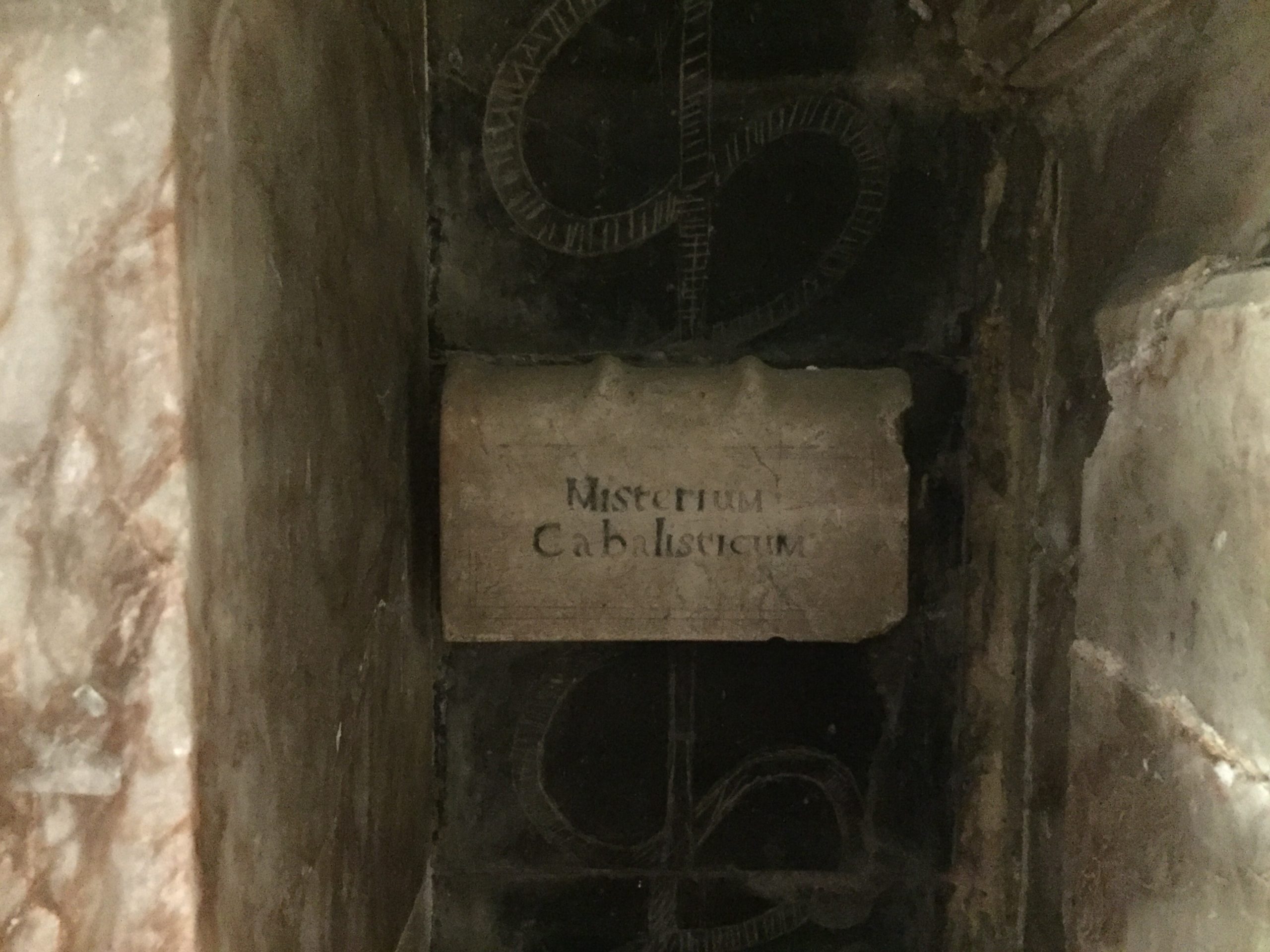
I carefully shifted a few things aside (I would put them back before I left). I could now see the lengthy Latin inscription. In the recesses on either side, running up from the floor, were faintly etched staffs with winding snakes: the Rod of Asclepius, ancient symbol of medicine. And in the left-hand recess were two smaller books with words inscribed. Looking closely, one was marked ‘Misterium Cabalisticum’, the other ‘Philosophia Sacra’. 

This was the monument to Robert Fludd, born in nearby Milgate House, and buried in Holy Cross after his death in 1637. The inscription tells us that he travelled abroad, ad recipiendum ingenii cultum – ‘to receive the cult of genius’ – before returning home and being elected to the London College of Physicians.

IMG_4917

Fludd was a doctor, but those two books of ‘cabbalistic mystery’ and ‘sacred philosophy’ suggest what he is best remembered for today: publications of occult science. In particular, his magnum opus Utriusque Cosmi, Maioris scilicet et Minoris, metaphysica, physica, atque technica Historia – ‘the metaphysical, physical, and technical history of the two worlds, namely the greater and the lesser’. 

Those ‘two worlds’ are the macrocosm and microcosm, as expressed by the Hermetic principle of correspondences between man and the universe: ‘as above, so below’. Utriusque Cosmi combines influences of Hermes Trismegistus with Christian Caballah, Astrology, and Alchemy, and includes a range of practical topics, from mathematics to optics, military strategy, and music. 

Screenshot 2023-08-22 at 13.18.50

Creative Commons.

Music, in fact, was particularly important to Fludd’s occult worldview, as can be seen in some of the sumptuous engravings that accompany his work. These visions, rich in wonder and mystery, have an enduring fascination – with tongues of flame, billowing clouds, and lines of radiating energy in geometric frameworks. And among them we find depictions of the monochord: a single-stringed instrument used to show the proportions of consonances, and a representation of universal harmony, or musica mundana.

For Fludd, in fact, the octave divisions of the string were a crucial metaphor for the universe. He positions the monochord at the centre of diagrams, running the scale from earth to God, matter to light, through the spheres of the elements, planets and angelic hierarchies. It also runs through the microcosm of man, representing the descent and re-ascent of the divine soul. In one engraving, a Monty Python-esque hand emerges from a cloud to adjust its tuning peg.

Screenshot 2023-08-22 at 13.16.32

Creative Commons.

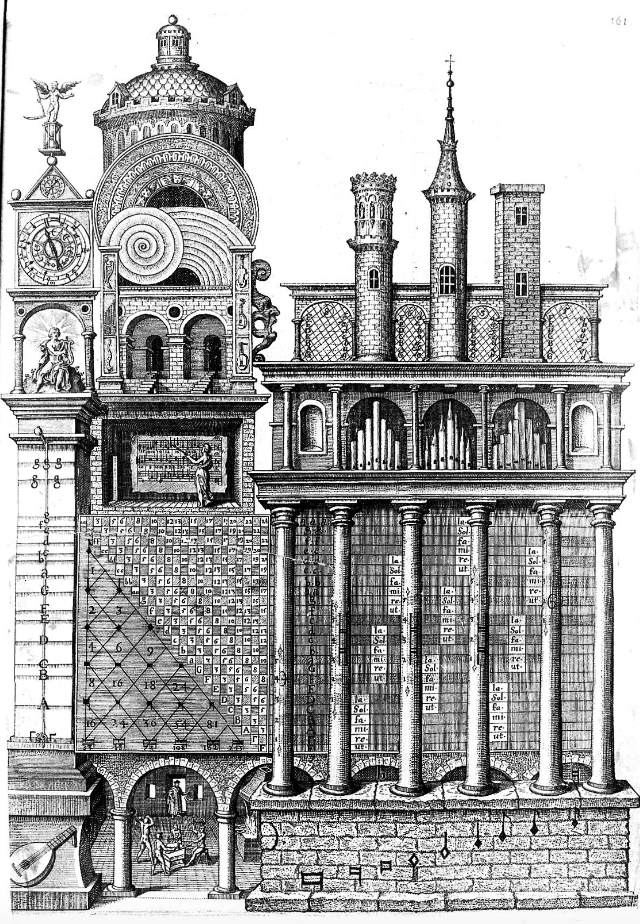
Another part of the Utriusque Cosmi covers practical music theory. For this, Fludd constructed a fantastical memory palace, a ‘Temple of Music’ festooned with musical symbols around its columns, walls and towers. Its scheme is populated by legendary figures – the muse Thalia gives a music lesson in an alcove, Pythagoras listens to the hammers of the smithy in another. Apollo sits with his lyre, representing harmony, while Saturn stands on an hour-glass for rhythm. Two doors symbolise the ears, a spiral the motions of the air. Fludd’s introduction invites us to imagine the setting as Mount Parnassus, surrounded by woods, fields and fountains, and filled with dancing shepherds, satyrs and nymphs.

Screenshot 2023-08-22 at 13.13.02

The Temple of Music, Creative Commons. 

This delightfully realised image showcases the Renaissance penchant for mnemonic devices. And in the final chapter of the treatise, Fludd turns to another intellectual fascination of his era: automata. He gives detailed instructions for building a mechanical psaltery, an instrument that can be hidden behind a curtain or a wall and play pavanes or galliards by itself, for the delight of dinner guests. 

Fanciful as all this may seem, Fludd’s ambitious publications, and the wondrous engravings that accompany them, have ensured him a place in intellectual history. In popular culture, he has also appeared in works of conspiracist fiction such as The Da Vinci Code, thanks to his association with the Rosicrucians. He wrote a defence of the two anonymous manifestos credited to that supposed secret society – the Order of the Rosy Cross – manifestos which were published to widespread consternation, promising great advancements of human knowledge for those worthy to receive their truths. 

Whatever the origins of those cultish documents, Fludd has perhaps inevitably been conflated with the Order, and assumed to have been a member. No doubt, the manifestos suggest an occult worldview very much in tune with his own. Among the Rosicrucian claims was a kind of singing, which could gather precious stones and move the princes of the world. In Fludd’s defence of the Fraternity, he writes of ‘wonderful music of true and mysterious power in every creature both animate and inanimate’. 

Much of Fludd’s work envisioned hidden forces behind observable reality, and so it seems somewhat fitting that this occultist’s monument is now locked away, sealed in Hermetic secrecy. I find his philosophy fascinating, partly because there is an appealing completeness to it, an audacious wholeness that opens up a different mental space to modern science, with its separate specialisms and materialist assumptions. 

And what, more precisely, is the nature of that appeal? As I’ve looked at the news this summer, with fires raging around the world, it’s been hard not to perceive a stark disconnect between the macro- and the micro-level events in our own time. We have highly developed and sophisticated science, the like of which Fludd could never have dreamed, informing us that our climate on which all earthly life depends is being systematically destabilised. But the microscopic trivia of the everyday still largely holds us in thrall, and enables its further destruction. For which you might ask: what is the point of all our intellectual progress? In four hundred years, it seems, we’ve travelled from universal harmony to universal cognitive dissonance.

IMG_4967

I locked the door, put the key back, and left the church to have a look round the grounds. There are three carved beasts perched atop the tower, and on a cloudy day that threatened rain, the whole scene felt suitably gothic. But as I was about to leave to catch the train back to London the sun came out, and Holy Cross Bearsted stood bright against the dark sky. 

My blog posts are powered by caffeine. You can support Corymbus by buying me a coffee on PayPal, or subscribing to my Patreon. For updates on new posts, sign up to the mailing list.

Further reading:

Peter Ammann: The Musical Theory and Philosophy of Robert Fludd.

Dante Diotallevi: The Case of Robert Fludd

Urszula Szulakowska: Robert Fludd and His Images of The Divine

Frances Yates: The Rosicrucian Enlightenment