The Dance Of Death

In my latest for Corymbus, I get morbid. In a time of widespread alarm about runaway climate change, could a medieval approach to death help us to better understand our place in the world? Featuring music by Orlando Gibbons, Thomas Adès and John Tavener. 💀💀💀 

The Heaventree Of Stars

The Starry Night by Van Gogh. Wikimedia Commons.

holsthousezoom      By Simon Brackenborough

I’ve recently been exploring the orchestral music of the Welsh composer Alun Hoddinott. It’s no short task: at his death in 2008 at the age of 78, he left a large body of work in a wide range of forms, including six operas, ten symphonies, and twenty concertos.

If you’re not familiar with Hoddinott, a good introduction to his sound-world is The Heaventree Of Stars, a short ‘poem’ for violin and orchestra. Commissioned by the BBC, it was first performed in 1980 by Christopher Warren-Green and the BBC Welsh Symphony Orchestra, conducted by Owain Arwel Hughes.

Much of what I’ve heard of Hoddinott’s music uses modern harmonic language, but it doesn’t revel in the brutality of dissonance. He has an affinity for sensual textures and quietly brooding ambiguity. His scores often create an atmosphere of dense mystery, with wells of rich colour and moments of eerie calm.

Hoddinott had a busy career as a composer and Professor of Music at Cardiff University, but he took a keen interest in the wider arts. His homes were filled with paintings and sculptures, and he had a large personal library. The Heaventree of Stars takes its inspiration from a line in James Joyce’s novel Ulysses. A famous exemplar of modernist prose, with its highly inventive language and wide-ranging allusions, it’s a book that rewards close and imaginative readings.

The two characters at this point in the novel, Leopold Bloom and Stephen Dedalus, step outside into the latter’s garden and contemplate the night sky. Joyce describes the sight that meets them:

The heaventree of stars hung with humid nightblue fruit.

We might spot how ‘midnight’ is hidden within the words here. And John Simpson has noted that the idea of a ‘heaventree’ links to Polynesian and Malay beliefs. But simply on a poetic level, this sentence is both atmospheric and musical. Say it aloud: the consonant obstacle-course and cluster of ‘u’ sounds makes ‘hung with humid nightblue fruit’ feel like eating a peach.

We cannot discount an erotic resonance in this steamy air and dangling fruit either, especially given the sexual episodes of the novel. After seeing the stars, Bloom returns home to his wife Molly and, in another oft-quoted line, the curves of her body are compared obsessively to melons. However you read it, this night seems charged with possibility.

Three Cliffs Bay on the Gower Peninsula, where Hoddinott lived in his later years. Photo by Allan Hopkins, Creative Commons, cropped.

‘Humid’ could be a good description of Hoddinott’s orchestral style too. Quite often a draught of Welsh damp seems to waft in; I particularly like his habit of combining long chords on woodwind and brass with sustained translucent string lines, like misty tendrils over dark hills.

I wanted to understand more about his orchestration, so I tracked down the score to The Heaventree Of Stars. What I found was a facsimile of the handwritten manuscript rather than a neat engraving. But this provides the advantage of a more personal impression of the composer.

As you’d expect from its nocturnal theme, much of the piece is relatively quiet. But it calls for three percussionists, with a much larger range of instruments than I imagined. Hoddinott uses this constellation of timbres in a way that suggests the heightened aural awareness of standing outdoors at night, hearing faint sounds of indistinct origin. Among these, a kind of gentle bending moan comes from a strange little contraption called the ‘flexatone’.

But the effect of this night sky is dramatically offset by an opening crescendo. This crashing wave of sound is like the crossing of a liminal space. It could be the ‘big bang’ that brings these stars into being, or – given the instruments include a wind machine and a thunder sheet – perhaps a passing storm.

When it subsides, our starry sky appears with high string lines. Particularly magical are softly fluttering arabesque figures that Hoddinott scores for woodwinds. He notates these with a series of pitch values, beamed but open-voided, and then a simple wiggly line to show continuation. This impressionistic device is used for various other instruments throughout the piece.

When it enters the scene, the solo violin part is rhapsodic, and unsurprisingly treads a lot of high-pitched ground. We could think of its climbing trills and undulating arpeggios as a modern chromatic equivalent to Vaughan Williams’ The Lark Ascending, with the jostling playfulness of Joyce’s prose replacing the lyrical ease of George Meredith’s poem. There are numerous differences in approach of course, but both scores excel in distilling a moment of enraptured stillness – of stopping to look up.

Towards the end of the work, the orchestra builds to a climax with Hoddinott’s typical slow-burning intensity. Languid chords from the bassoon and horns underpin a roaming melody on the violins and string figurations. But it passes, and nocturnal stillness returns. The solo violin finally ascends with a series of simple harmonics, met by a soft, ambiguous cadence on the strings. The sound is darkened by wind machine and tam-tam as it evaporates into the warm night air.

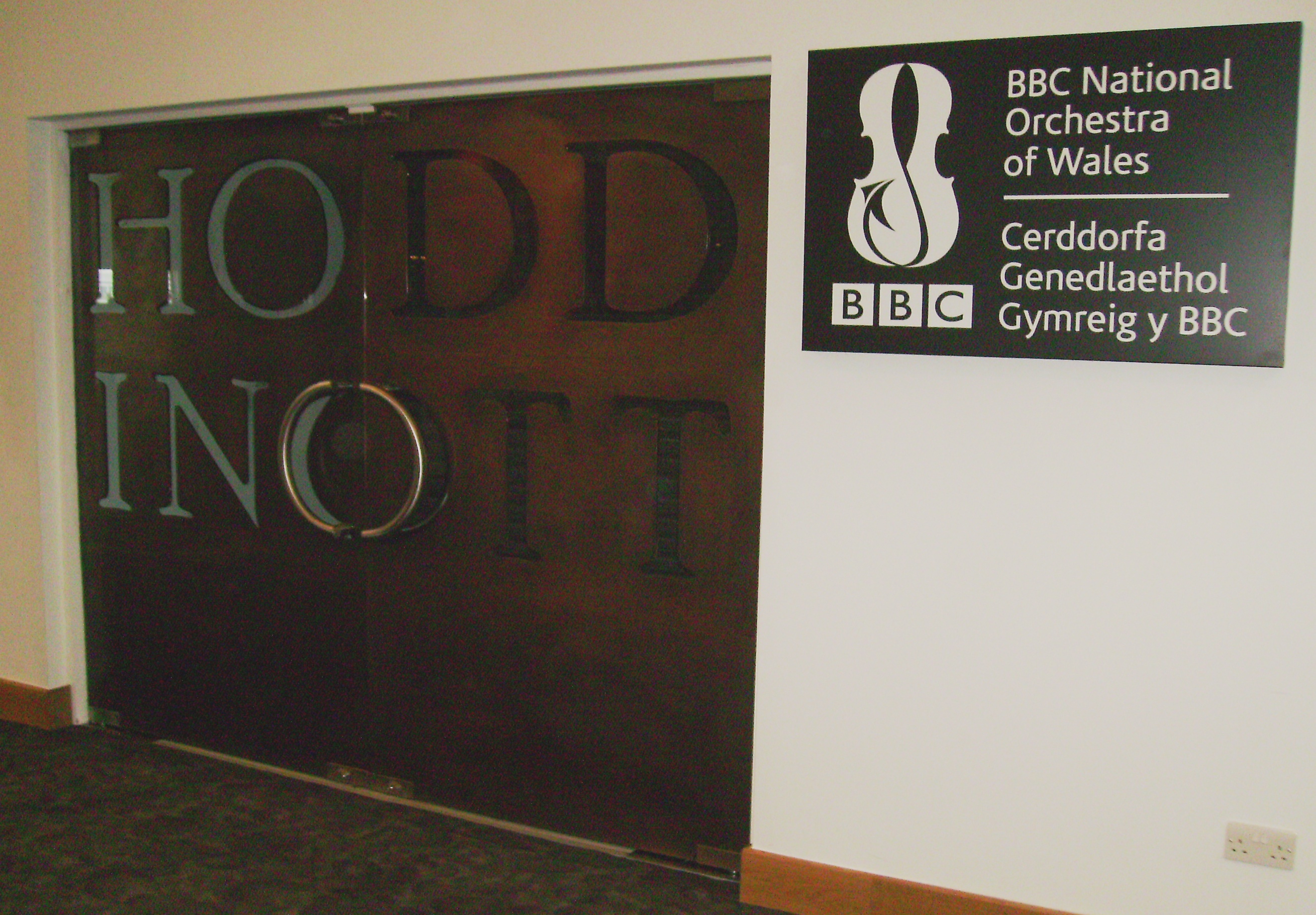
In a 2008 Guardian obituary, Geraint Lewis described Hoddinott as ‘the genial father-figure of Welsh music: he, more than anyone, directed its postwar path to full professionalism and creative renewal’. In the 1970s, with this internationally-recognised figure at Cardiff University’s new music department, he writes that ‘it felt as if musical life in Wales had suddenly been catapulted into a different dimension’. After the composer’s death, the concert hall at the Wales Millennium Centre was named BBC Hoddinott Hall in his honour.

Doors to BBC Hoddinott Hall. Wikimedia Commons.

If you’d like to venture on to something with bigger symphonic bones than The Heaventree Of Stars, I recommend Hoddinott’s vibrantly colourful Landscapes. You might also try his final orchestral piece, Taliesin, which shows that he composed with undimmed imagination right to the end. Its subject is an ancient poet, shrouded in the mists of legend, whose supposed works feature in a Middle Welsh manuscript. A fitting valedictory theme, for a man who gave so much to Welsh cultural life.

My blogs are powered by caffeine. So if you enjoyed this one, a cheap but meaningful way to support my writing is to buy me a coffee on PayPal.

So Many Stars

I’m a big fan of brevity (you might not believe it from my blog posts, but it’s true). I even wrote my university dissertation on Walter Willson Cobbett’s ‘Phantasy’ form – designed to be the chamber music equivalent to the overture or prelude (see the article I made from it here).

So I was intrigued to discover that violinist Fenella Humphreys and pianist Nicola Eimer have released a new album of violin sonatinas. The sonatina is a strange diminutive beast, retaining the multi-movement structure of the sonata while reducing its scale. It’s a name that almost begs you not to take it seriously – the sort of title you might expect to come across in a lower-grade instrumental exam book. But perhaps my favourite violin sonata – Rubbra’s 3rd – is short enough to be a sonatina in all but name anyway, so this felt like familiar ground.

What these shorter pieces allow for, of course, is greater variety within a programme, something alluded to in the lovely title ‘So Many Stars’. This comes from a diary entry by Sibelius – one of the six composers featured – around the time he was writing his sonatina, and it’s a nice metaphor for taking delight in a multitude of small things. 

He’s probably the biggest name here in a group covering 20-21st century music, though all towards the more tonal end of the spectrum. And this disc shows that these sonatinas – all in three movements – are no mere trifles, but make for compelling listening. The form has been a tempting small canvas for composers early in their careers, such as Françaix and Alwyn, but it can also be a neat way to bring together odds and ends – Gordon Crosse’s sonatina was written quickly after hearing Humphreys perform in 2010, ‘using a combination of old and new material’, while Cheryl Frances-Hoad reworked a cello piece.

Humphreys has become a reliable champion of lesser-known repertoire, and particularly British composers, of whom we have four here (her recent recording of the Doreen Carwithen sonata is particularly wonderful). What’s refreshing about this selection is that the works by Alwyn and Berkeley are not quarantined away on an all-British discs, as is so often the case. (In a conversation on Twitter, Humphreys revealed that it’s easier to get funding for all-British discs, which goes some way to explaining this trend, and that’s a pity, because it’s great to be able to make connections to composers across the channel – otherwise it creates the impression that British music of this period had a kind of parochial existence, unconcerned by what was happening elsewhere.)

Their two lyrically-inclined pieces bookend the album, but this collection also showcases composers in a less familiar guise. Françaix is better known to me for his wonderfully witty music for woodwind, but his sonatina nonetheless provides an effective outlet for his suave, impish humour. Sibelius is not greatly renowned for chamber music at all, but his work is very charming indeed.

Frances-Hoad’s piece probably has the most weight and intensity behind it, with the unusual format of two slow outer movements, her middle movement dancing with harmonics, and culminating in an intensely expressive lento. Crosse – a new name to me entirely – uses minimal piano accompaniment to particularly stark effect.

All in all this is a very rewarding disc, which commendably side-steps routine programming. 

‘So Many Stars’ is available from Stone Records. Listen on Spotify or Apple Music, and read the liner notes

Littlecote Villa: An Orphic Mystery

An apse of the Littlecote Park mosaic.

holsthousezoom      By Simon Brackenborough

In the south of England, in a field beside the river Kennet, a man holds a lyre. A dog sits by his side, while around him pace four women in a circle, each with a larger animal – a goat, a deer, a panther, and a bull.

This strange scene forms a mosaic a floor in what was once a Roman villa complex, now part of the grounds of Littlecote House. It’s a grand Elizabethan manor lying just outside of Hungerford in Wiltshire, and has plenty of its own history – it’s widely claimed to be the third most haunted house in Britain.

When I recently drove to Littlecote, it was a bitterly cold January morning. A flock of sheep grazed nearby as I stood shivering, looking down at a mosaic floor first laid over 1600 years ago. Having been restored to its former glory from the ravages of time, it’s now protected from the elements by a wooden roof structure.

Littlecote Park.

And here he was: Orpheus. First described by the ancient Greeks, and adopted by the Romans – one of the most enduring poets and musicians in western culture. From the earliest days of opera, composers and librettists have been drawn to him, particularly the story of his descent into the underworld in a doomed attempt to rescue his love, Eurydice. From Monteverdi to Birtwistle, Orpheus has sung for us again and again.

In Christian iconography, we’re accustomed to musicians playing a supporting role – choirs of angels, silver trumpets. But for Orpheus, music and poetry are his fundamental godly powers. I wanted to know what it meant that he was here, in this English field, clearly the focal point of this design?

The western section of the Littlecote mosaic.

At first glance, you might think that this mosaic tells us something about the esteem in which music was held in Roman society. But after my visit, I took a trip to the British Library, which allowed me to dig into the scholarship of Littlecote Park. It turns out that this mosaic, and its symbolism, is much more contested than I imagined. It demonstrates the fascinating ambiguity of ancient images, and our ability to read them in multiple different ways – even at the same time.

‘The finest pavement that the sun ever shone upon in England’ were the words of antiquarian Roger Gale after the mosaic was unearthed in 1727 by the steward of the park estate, William George. We know that George made a coloured drawing of the design, which was later engraved, and his wife embroidered a large needlework copy as a memorial after his death, which now hangs in Littlecote House.

Littlecote House.

These detailed records, as it turns out, would be invaluable. Because as crazy as it seems today, the site of the villa was somehow lost. Poor Orpheus descended into the underworld once more, where he lay reburied for over two centuries.

Some presumed the mosaic destroyed. Then, in the summer of 1977, the site was unexpectedly found for a second time. Bryn Walters, who led the new excavation, explains that Littlecote tradition assumed the villa to be somewhere on the nearby hillside. But it turned up on the banks of the Kennet instead, in ‘a small oak copse choked with weeds where moles and rabbits had brought fine mosaic tesserae to the surface’.

Sadly, the animals and roots had badly damaged the floor – only forty percent of it was preserved in situ. But since the full layout was already recorded, ‘it was decided to take an unprecedented step and fully restore one of the most significant mosaics yet found in Britain’.

After the floor was fully excavated, the surviving panels were cleaned and re-set, while the most damaged parts were relaid with modern tiles. Luckily, Orpheus himself was pretty much intact. But if the story of its discovery is surprisingly complex, the debate around the mosaic’s purpose and meaning is even more so.

Littlecote Roman villa ruins.

Orpheus was the son of the muse Calliope. Some cite his father as Apollo, who gave him his lyre, others a Thracian king. He was said to be able to charm animals with his music, and mosaics from across the Roman empire show him surrounded by beasts of various kinds. But there is a cluster of Orphic mosaics in the villas of the south and west of England, many with the distinctive feature of animals parading in a circle. The most spectacular of these is at Woodchester in Gloucestershire, a square floor of nearly 15 metres across, made up of 1.6 million pieces.

Today, the idea of music as a means to control nature might seem a strange one. But in a conference paper, Sarah Scott offers a rationale for the appeal of Orpheus to wealthy British Romans of the fourth century – a time of an increasing concentration of land ownership, in which rural residences were becoming ‘the primary centres for status display’:

Orpheus was able to control nature in its strongest and wildest forms without the use of physical force, and would therefore have been an appropriate choice for a room in which the owner would have conducted business, and entertained friends and/or strangers, and generally aimed to impress. The villa owner was associating himself with godly powers. […] The animals traditionally found on the Orpheus scene are those which exhibit types of behaviour which make them difficult to handle or capture.

The number of such mosaics in Britain, she suggests, may be down to a copycat behaviour – a kind of keeping-up-with-the-Jones’s among the large landowners, perhaps with Woodchester’s magnificent floor as the original inspiration.

The Littlecote ‘Orpheus’.

But even within this Roman mosaic tradition, Littlecote offers some puzzling features. It’s in a separate building from the main domestic house, without the hypocaust to provide underfloor heating. And Orpheus himself looks unusual too, to the extent that scholars such as Jocelyn Toynbee have even questioned his precise identity:

The central figure has, indeed, Orpheus’s characteristic lyre and Phrygian cap; and the animal beside him could be (as it has now been restored) the fox or dog that so often accompanies him […] But he has not got the short cloak, short tunic, and trousers and boots in which Orpheus generally appears in works of art in every medium; nor is he seated or crouching and charming with his music a spell-bound audience of often numerous animals and birds […]

An Orpheus mosaic from Palermo, Italy. Photo by Giovanni Dall’Orto, Wikimedia Commons.

The lyre and long robe of the Littlecote figure are, however, appropriate for Apollo, who Toynbee suggests this could be, albeit displaying two ‘Orphic traits’ of cap and dog. Apollo is associated with the sun, which would make sense of what appear to be radiating sunbeams in the three apses attached to the room.

But there are yet stranger details to consider. The ‘sun’ in these apses seems to have the face of a cat. Meanwhile, two panels in the eastern section depict large cats (or perhaps dogs) either side of a cantharus – a wine cup. In one of these panels, the cats have fish tails instead of hind legs, while either side of them are two marine animals, possibly dolphins.

Littlecote mosaic, eastern end.

Walters’ excavation report provides a reading of the design which pulls these cryptic elements together. He thinks the common theme of Orpheus controlling nature through music doesn’t apply, but rather, ‘on this floor Orpheus acts as a catalyst, by which all the powers and identities of the classical pantheon are absorbed into a single god-head’.

He sees the ‘unorthodox’ rendering of Orpheus as representing ‘the prophet-priest of Apollo-Helios’, while the feline elements and wine cups draw on Bacchus – also known as Dionysus – the God of wine for whom large cats were a common symbol.

The double meanings don’t end there. The four circling women he interprets as the seasons, but characterised as Goddesses – which, running from spring to winter, are Aphrodite (rebirth), Nemesis (youth, holding a swan to represent Zeus), Demeter (maturity), and Persephone (death). This means that as you entered the room from the eastern end, you would be faced by Demeter and Persephone – ‘the chief deities of Elysium’. In front of them, a rectangle of zig-zag lines is comparable to stylised illustrations of water seen elsewhere in the Roman world. Walters suggests this might be the legendary ‘Pool Of Memory’, of whose waters pure souls could drink from to escape the ‘Wheel Of Birth’ and enter Elysium.

Littlecote mosaic, central section.

The circling animals with the seasons he sees as representing the myth of ‘the flight of Zagreus-Dionysus from the Titans’, in which a series of animal transformations aided his escape. And of the curious ‘sea-cats’ and their wine cup, he cites the ‘Tyrrhenian pirate myth’:

In revenge for his sacrilegious abduction, Dionysus transformed himself into a fearsome lion-like monster, cast his wine cup into the sea and changed the sea into wine; the pirates in terror leaped from their vessel and were changed by Dionysus into dolphins as they attempted to swim away.

This scheme comes together in the apses, the feline faces of Bacchus/Dionysus ‘now unified, through the intercession of Orpheus, with Apollo-Helios’. But as Martin Henig has noted, these sunbeams also have a potential double meaning as pecten shells, a resonance with the other marine imagery, which perhaps recalls ‘the voyage of the soul over sea to the Blessed Isles’.

Taking all this into consideration, Walters sees this hall as a temple of some kind, and ‘probable evidence for a neoplatonic religious guild among the elite in late Roman Britain’. Some scholars agree – Henig calls Littlecote ‘the best contender for a pagan cult-room attached to a Roman villa in Britain’.

Orpheus and Eurydice, by Edward Poynter. Wikimedia Commons.

There is certainly evidence for Orphic cults in the Classical world, and Walters’ excavation report lends some historical context to this claim. In over 350 years of Roman activity at Littlecote, the mosaic room was constructed as part of a late redesign of the building it was attached to, which included a large courtyard and a bath suite. Coinage found in the building, minted at Trier in Germany, suggests a date for the hall’s construction as c. 360 AD. This, as Walters tells us, is ‘most intriguing’:

Julian, kinsman of Constantine I, became emperor of Gaul in A.D. 360. As Julian II he is best known as ‘The Apostate’ owing to his attempt to supplant Christianity with a revival of Classical paganism. Julian bestowed great favours on those who readily observed his directives for the restoration of pagan worship. […] It may perhaps be reasonable to suggest that this remarkable building was constructed to celebrate the accession of the new emperor […]

The ‘Great Plate Of Bacchus’ from the Mildenhall Treasure, discovered in Suffolk and thought to date from the fourth century. Photo by JMiall, Wikimedia Commons.

This rather grand hypothesis of an Orphic temple is both plausible and thoroughly fascinating – perhaps, suspiciously so. A scheme so rich in esoteric meaning is surely the most interesting answer we would want to believe. Is Walters guilty of reading too much into these images? Could a more banal explanation for this room be just as likely?

Other scholars seem to think so. Scott suggests that the room may have been an elaborate reception hall, in a way that reinforced the ‘rigidly ordered’ society of the time:

It may have been here that the owner met his clients, perhaps appearing in the apse at the far end. The villa owner kept his public and private life separate, and perhaps only a privileged few would have been admitted to the main building. The mosaic itself, with its complex religious images, would have emphasised the formality of the architecture and the superiority of the villa owner. Those visitors who lacked the necessary education would have been excluded from the significance of the design, and their social distance from the villa owner would have been further emphasised.

Toynbee, meanwhile, suggests that the ‘Orphic’ Apollo could be entertaining diners in ‘a summer triclinium [dining room] separate from the villa and built for coolness’ sake near the river’, perhaps with ritual banquets held in his honour. She is unconvinced by the Bacchic significance of the panels, and merely sees ‘a common decorative motif for filling horizontal spaces’, which ‘need not have any special religious connotation here other than as symbols of prosperity, fruitfulness, and teaming life in general’.

Of course this is only a floor, in a room that may have had numerous other objects and forms of decoration. The absence of further evidence makes any certain explanation of its function impossible. But a few finds from the vicinity of the site nonetheless offer tantalising glimpses of Roman life here.

A beautiful red Carnelian intaglio was found in the villa’s surrounding fields. It seems to show Victory crowning Fortuna, and likely fell out of someone’s ring as they were walking. Then in 1985, two hollow-cast bronze busts were discovered nearby. These were buried back-to-back, concreted together by corrosion, and Walters determines that they were deliberately concealed in antiquity, though ‘whether they formed part of booty taken from the villa, or loot from a sepulchral deposit cannot, for the time being, be answered’.

Henig interprets one of the busts as a likely Bacchus/Dionysus, while the other, sporting a remarkably full head of hair, resembles Antinous, the real-life ‘beautiful favourite’ of the emperor Hadrian (some say also his homosexual lover) who was later venerated as a God. Strikingly, he emerges chest-deep from a calyx – the budding petals of a flower.

Henig writes that ‘Dionysus and specifically Dionysus-Zagreus seems to have an important place in these mysteries which may generally be described as Orphic. The new bronzes must surely be associated with this cult’. With their date possibly a century earlier than the mosaic hall, he suggests they may have been fittings for a piece of furniture which was already an antique in the villa’s later stages.

Whether the mosaic was part of a cult room, reception area, or dining hall, it cannot tell us what role music might have played in the villa. But in its hierarchical ordering, with the lyre-player surrounded by women and animals, we have a compelling view of music as a metaphor for power.

Of course, with modern eyes, there are other ways to read this particular arrangement. With its man at the centre, we could see a picture of patriarchy. We could see a mentality of entitlement to control and exploit nature – the legacy of which, over 1600 years later, is rapidly propelling us to an ecological crisis.

Topiary yew trees at Littlecote House.

The debate around the mosaic raises a duality which is common to both religion and classical music: both can be the subject of a genuine deep engagement, but both can also be appropriated, in a shallow way, as a signifier of class and respectability. So yes, this room might well have been a site for pagan revivalists to engage in solemn mystery rites beside the river Kennet. But equally, it might just have been a fancy floor decoration for a wealthy landlord, who was drawing on ideas of music, nature, and religion in order to bolster his status in a highly unequal society.

But whatever the reason for this beautiful mosaic, its place in the villa’s life was surprisingly short. Walters’ excavation determined that the Orphic phase lasted ‘no more than twenty years’, after which the villa house was demolished, and the mosaic building became ‘a lowly dwelling’.

The chapel at Littlecote House.

Littlecote Park is free to visit, though it’s fairly inaccessible without a car. If you make the trip, I certainly recommend looking around the manor too. Aside from its haunted rooms and large gardens, its dourly Puritanical chapel from the Civil War era provides a wonderful aesthetic counterpoint to the opulence of the Roman floor, and is claimed to be the only one of its kind. 

The only complaint I could make of the current state of the mosaic is an ironic one: that Orpheus might be better protected from nature. The beams of the roof structure have attracted roosting birds to leave their particular unmistakable marks all over the walkways, and even some parts of the mosaic itself.

When I visited, I found Orpheus garlanded by a couple of stray twigs too, presumably from the same source. Perhaps a bird of Wiltshire was honouring him, much like Victory honours Fortuna in the ring stone found nearby. Even in his terracotta silence, it seems that nature cannot resist this musician’s charms.

My blog posts are powered by caffeine! If you enjoyed this one, a cheap but meaningful way to support my writing is to buy me a coffee on PayPal.

Bax’s third symphony – West Forest Sinfonia

Two years ago, I heard the Berkshire-based West Forest Sinfonia perform a concert of all-British music in the Great Hall at Reading University. Culminating in Bax’s rarely-heard Spring Fire, it was an excellent concert, and for a non-professional orchestra, the standard of playing was impressively high. Also impressive was the old brick hall itself, which – not nearly as cavernous as its name suggests – provided a great up-close-and-personal listening experience. 

It so happened that a few weeks ago I decided to check what this orchestra were up to, and I nearly fell off my chair. They were shortly coming back to Reading to play another piece by Bax. It’s one of my all-time favourites that I’ve loved since I was a teenager, and it’s virtually never performed live: the third symphony. The only time I’d heard it in concert was way back in 2003, with Vernon Handley conducting a student orchestra at the Royal Academy of Music. 

I wrote a long article about this symphony on Corymbus – which for several years after its premiere was widely performed and popular with audiences, under the baton of Henry Wood. But post-war, and post-Wood’s death, it faded into obscurity.

Strangely, I felt nervous as I drove to Reading. It’s an odd situation, to go and listen to a work you love this much when you’re accustomed to hearing from just a handful of recordings. You have to be prepared for it to sound different. Tempos might not be what you’re used to. Details might jump out that you’d never noticed before. I tried to remove expectations, and be prepared to hear this piece afresh.

It’s also strange knowing you’re likely one of a select few in the audience who know such a neglected work. Family and friends of the orchestra members may not have heard any Bax, or even heard of him. You end up feeling a little protective of the music, a bit concerned for its welfare. You worry that the performance won’t really show how special it is. And you know that such a complex piece can never mean as much to someone on a first hearing as it does to you – not when its contours have been so well digested over years of loving listening.

West Forest’s conductor, Philip Ellis, gave a frank pre-concert speech about discovering the symphony, what a masterpiece he thought it was, and Bax’s endlessly inventive use of harmony. He also provided context about the composer’s turbulent love-life, citing a ‘catholic guilt’ about his extra-marital affairs in the score’s more anguished moments. Ellis clearly loved the piece, and told us that he chose to put it in the first half, so that the players were as fresh as possible to give it the best performance they could. He admitted that it was very difficult to put together, and get right – one possible reason why it’s never played by orchestras like his.

Well, Ellis and the West Forest Sinfonia really gave it their all. I chose a seat mid-way through the audience, and was perhaps only ten metres away from the musicians, able to absorb every detail. And my God. WHAT a score this is. 

With recordings, it’s easy to forget the raw, heart-pounding power of that first movement when heard in the flesh – how viscerally thrilling those wild, roller-coaster passages are, with the ostinatos grabbing you by the scruff of the neck and giving you a savage shake. Ellis kept his tempos admirably brisk – Vernon Handley always warned against the dangers of wallowing in Bax, you’ve got to keep pulling the music along – and he did so brilliantly. His left hand shaped each flourishing melodic line, and he seemed to smile almost constantly throughout. It was clear he really believed in this music.

The only disappointment in the first movement was a small but important one – the anvil strike at the climax didn’t seem to be an anvil. I couldn’t see what was used, but it appeared to be hand-held, and had a weak sound. You want a real metallic clang here. Admittedly Bax made things hard for himself in calling for such an unusual instrument. (Interestingly he originally scored a cymbal crash – a much more obvious choice – but the manuscript has anvil penciled in instead, seemingly in Henry Wood’s hand, from the first rehearsals. I have my own theory as to why this was changed – Bax’s approach to scoring throughout gives us strange, shadowy sounds, and the weirdness of the anvil, the hardness of its timbre suits the atmosphere of primeval ruggedness running right through this movement).

But such instrumental subtleties blossomed beautifully in the second movement, with its softly glowing chords, tinkling celesta, and lush divided strings. Special mention must go to the solo horn and trumpet players, both of whom have terrifyingly exposed quiet solos lines and who rose to the challenge magnificently. When the trumpet solo shone through with its woodwind and brass choir, like sunlight falling on a pristine landscape, it brought tears to my eyes.

And so it came to the boisterous last movement, full of vivacious, joyous energy, transitioning audaciously to the serene epilogue, which Ellis again took with an admirably firm tempo. After the ear is accustomed to so many crunching chromatic harmonies, it’s a shock to hear this wash of diatonic loveliness – a real step beyond. In a way it’s a gallingly crude device with which to resolve the symphony’s narrative, but Bax gets away with it because this music is just so beguilingly magical, with its passing dark clouds reminding us of where we’ve come from even as he takes us away to a place of impossible tranquility. The reprise of the searching, ambiguous four-note figure of the opening movement, once thrashed to within an inch of its life, now comes back like a ghost and, in the very last bars, finally resolves itself into an attainment of sublime peace. 

It was, simply, a wonderful performance of an astonishing symphony. You’ll forgive me in my child-like excitement of hearing this work live if I say that the second half could never live up to that. William Alwyn’s short Autumn Legend for cor anglais and strings is a pleasant enough work, without ever setting my world on fire – but even after the interval break, its subdued sound-world seemed weak compared to the epic journey we’d just been on. Of course it would have made much more sense as a concert opener to get things started, but given Ellis’s reasons for switching, I can hardly complain. Elgar’s In The South, on the other hand, made for a suitably rousing finish. Its surging violin lines and good-natured extroversion was a sunny Mediterranean send-off that nicely complemented Bax’s clouded mountains. 

I urge anyone in south-east England to keep your eye on West Forest Sinfonia – they are a very good ensemble, with a fantastic conductor unafraid to put on less familiar repertoire. Wouldn’t it be nice if members of our national press could pop on a train from Paddington and review concerts like this? Whatever differences in finesse exist between this group and a professional orchestra, they’re not nearly as great as you’d think. And they are more than made up for by being able to hear such a rarity, up close in a bright-sounding concert hall, given a performance of such genuine dedication and conviction. Perhaps the most revealing fact about the afternoon was that there was barely any coughing or throat-clearing from the audience – and that’s at the height of the cold season. In my view, that’s a sign of people’s attention being gripped, and not lagging: the highest praise. 

It makes you think. Who needs a new London concert hall? Who needs London at all? I may be biased by my long-term love affair with Bax’s third symphony, but the £15 I paid here felt as good value for money as hearing any of the best ensembles, anywhere.

#SoundState at the Southbank – who’s listening?


On Saturday, I went to London’s Southbank Centre for two events in their five-day SoundState festival, which ‘celebrates the artists who are defining what it means to make new music in the 21st century’. First up was a panel discussion, ‘It’s New Music, But Who’s Listening?’, followed by a concert by Ensemble Modern, playing pieces by promising young composers.

The discussion was chaired by Fiona Robertson, director of Scottish new music festival ‘sound’, and included three composers on the panel – Sally Beamish, Dan Kidane, and John Harris – the last of whom is also the director of Red Note Ensemble and festival director of New Music Dublin.

Classical music has a very hypochondriac culture – and there is nothing that people in the industry love more than wringing their hands over the larger audiences that ought to be the sign of a healthy art form. Look, I’ve done it myself, ok? But thankfully, this talk was more than this, and it did provide some valuable insights, from the panelists and some of the audience members.

That said, you can never cover every relevant point in a 90-minute conversation. The fact that Fiona and John both work in organisations dedicated to new/modern music swayed the discussion to the question of audiences for concerts wholly of this repertoire. So the issues of mixed concert programmes, and of composers being in dialogue with established repertoire, were somewhat left aside – even though this is probably how the average concert goer is most likely to encounter a new piece.

Fiona started things off by asking what the problems were in getting new audiences to come and hear new music. John Harris brought some valuable insights from his own group’s research into the (basically working-class) ‘C’ and ‘D’ demographic groups. They were surprised to find that there was no lack of interest in classical music – even contemporary classical – but that lots of people didn’t feel like they would ‘fit in’ in a concert hall. 

John’s response to this finding felt like a very valid point – that we can’t expect people to cross that threshold if we’re not willing to cross theirs. He cited what might be called ‘outreach’ work he’d done in deprived areas of Scotland, playing modern classical in primary schools, pubs, and shopping centres, often with very positive results.

Sally spoke about the simple fact that listening to a new piece of music is difficult. For many it can be hard to admit to this, and people worry that if they don’t get a piece of music on one hearing, it’s their fault. This is a shame, and her honesty here was welcome. Music needs time to get under your skin (as to her suggestion that introducing a more visual element might help, I recently wrote about that issue here). 

Dan picked up on this point, and spoke of thinking carefully about the music from an audience’s point of view. But the extension that wasn’t really explored was that some music is easier to pick up on straight away, or leave a stronger impact on a first hearing. The use of repetition, for example, is incredibly important for music to stick in the mind, as is the formulation of memorable melodic ideas or other distinctive features. So there is a question of compositional choice at play.

Had I felt more provocative here, I might have put my hand up to say that contemporary classical music already has a huge audience – and his name is Ludovico Einaudi. Yes, he’s at the simple and tonal end of the spectrum, but that doesn’t mean that other composers can’t learn from him for the above reasons. And, perhaps more importantly, an overlooked aspect of his success is that his piano music is also within easy reach of amateurs to play themselves. There is a question to whether too many composers rely on the incredibly high standards of professional musicianship in the way they compose, complete with extended techniques. On this occasion the conversation didn’t go there, but Sally did talk of the importance of writing with knowledge of an instrument and with performers in mind – citing wrist damage she’d suffered while getting her fingers around some Boulez in the 80s. Fiona also made good points about how she’d been able to embed music in her local village community with her projects, by getting people involved with doing voice recordings for example, or writing words to be set to music about their environment.

It’s clear the contemporary classical scene is enormously diverse and fragmented – for that reason, John noted, it doesn’t have a tribal identity. There was agreement that a climate in which anything goes is a good thing, but it can make it harder for audiences to know what to expect. Some new classical music has more in common with contemporary electronica or jazz than it does Bach and Beethoven. 

So how do you get to the people who don’t know they will like what you’re doing? Interestingly, Fiona cited her experience that it’s often harder to make people with some amateur classical training interested in contemporary music than it is those who have no training and therefore fewer preconceptions. Nonetheless, the importance of music education got its mention, and diversity of representation too. But one avenue that was left unexplored was the role of the media, and what more the BBC and the wider musical media could be doing in its arts coverage to educate the public about the contemporary music scene. 

There was little time to network after the discussion, and I made a beeline for the Queen Elizabeth Hall, where Ensemble Modern were performing five works by young composers, conducted by Vimbayi Kaziboni. I’m not so au fait with all the new music subgenres, but this seemed to be as solidly and enthusiastically ‘experimental’ repertoire as you’d expect from an ensemble with their name. 

Some disclosure: I came to this event as someone who is interested in new music but by no means immersed in it. In the right frame of mind, I can enjoy new music at its most abrasive and weird, but I generally prefer music that retains at least a vestigial relationship to tonal shapes – like the most recent piece I featured on Corymbus. Without some kind of dialogue with tonality, I find, music becomes a very remote experience, detached from what’s in the everyday musical ecosystem. It can still be fascinating, and stimulating, and even beautiful at times, but it also incurs a mental cost in adjusting yourself to listen to it. It’s hard, as Sally said – and it’s not always clear why this effort is worth it.

On the other hand, if you’re going to listen to uncompromisingly atonal music, then up close and personal in a concert hall with a virtuoso ensemble is the best way. This particular selection of works made for a highly stimulating, and at times exciting, 90 minutes. 

A potential problem for audience engagement is not just that musical language has become a free-for-all, but the withering away of standard structural forms too. To this end, the programme notes by Mark Parker were excellent (and most importantly, provided free), and very helpful in guiding me through what I was about to hear. His introduction to one piece, Ashley Fure’s ‘Feed Forward’, made a point that revealed much about the aesthetic of the whole concert, and perhaps the festival:

The physical nature of sound is obscured when we imagine it only as something abstract. The bodies making these sounds, the vibrations they produce, the whole space encountered as something unavoidably present have become increasingly standard concerns of new music.

Sound, SoundState – what happened to ‘music’, you might ask? If the quasi-scientific language of ‘sound’ seemed revealing, so did the festival logo behind the stage, its glitchy typeface evoking the dystopian cool of Black Mirror. And the words in the piece titles either suggested a degree of violence – ‘Cut’, ‘Skinning’, or at least some kind of motion – ‘Feed Forward’ ‘Runaround’. Someone (I forget who) once tweeted of how video game composers longed for the sonic opulence of the symphony orchestra, while modern concert composers were running a mile from it. In this concert, we certainly experienced a classical aesthetic that shunned the velvet curtains of glamour and prestige, and enjoyed playing with sounds with the grittier, rough-edged contours of our concrete concert hall.

Particularly memorable was Martin Grütter’s Die Häutung des Himmels (‘Skinning the Sky’), which used a percussion section halfway up the audience, with a musical saw employed to some ethereally beautiful effects. At one point a loud crash from this area caused the conductor to look round –  one of those new music moments where I’d have otherwise assumed whatever had happened behind me was simply part of the score. Most of the works were admirably concise – my only quibble was with Feed Forward, whose lugubrious tone clusters trespassed on my patience, and the fact my enjoyment of the final witty Runaround was hampered by growing physical discomfort – after a second session of 90 minutes sat down in succession, the Runaround I needed was my own. 

This was certainly a concert to leave you marvelling at the breadth of sonic potential. But what it wasn’t, for me at least, was particularly moving, nor did I feel like I’d been told emotional stories. To have the component forces of your music deconstructed and remixed can be intellectually engaging, dazzling, and fun, as it was here. But I still find that it’s in familiar forms, either at the smaller or larger structural levels, that facilitate human storytelling more easily. 

Nonetheless, Ensemble Modern succeeded very well on their own terms, terms which equated to a very appreciative Queen Elizabeth Hall audience, at perhaps 50-60% full. Of course it’s quite possible that these five young composers are happy with the highly engaged audience they already have. But as to the question of increasing it, then I think back to what John said, of how you need to cross the threshold, which surely also applies to how we write music too. 

In the talk, Fiona got closest to the hand-wringing mode when she worried that composers who try to think of a wider audience could become too mainstream and ‘dumb down’. But I see no reason why a composer shouldn’t cross the would-be listener’s threshold by composing something that bears some kind of intuitive resemblance to familiar musical forms. Because despite the branding trying to persuade me otherwise, I would still wager that for many of us – perhaps the majority of us – sound and music are still two enduringly,  enjoyably different things. 

The Way Of The Water

Zhao Mengfu, Herding Horses In The Countryside, Wikimedia Commons.

holsthousezoom      By Simon Brackenborough

The horse has hooves to tread the frost and snow, a coat to chase away wind and cold. It champs the grass and drinks the stream, it lifts the knee and prances. Such is the nature of the horse; it needs no lofty halls, and no palaces.

These are the opening lines of Judith Weir’s 1998 song cycle Natural History. Commissioned by the Boston Symphony Orchestra, it was composed for the voice of the soprano Dawn Upshaw. It’s also one of the most fascinating and beautiful pieces of modern classical music that I’ve recently come across.

At first glance, the title Natural History might suggest science. But in her programme note, Weir tells how she became interested in Chinese philosophy as a teenager, through the writings of John Cage. For this commission, she chose to set passages from a collection of Taoist writings thought to have been written by a man called Zhuang-Zi, in the fourth to third century BC.

Her selected extracts, ‘considerably compressed’ from a translation by A.C. Graham, are described as ‘short parables about natural life as lived by different species, human and animal; a Taoist Carnival of the Animals, in fact’. This intermingling of animal and human concerns also offers a way in to the Taoist world of Zhuang-Zi, as A.C. Graham explains:

In the landscape which he shows us, things somehow do not have the relative importance which we are accustomed to assign to them. It is as though he finds in animals and trees as much significance as in people; within the human sphere, beggars, cripples and freaks are seen quite without pity and with as much interest and respect as princes and sages, and death with the same equanimity as life.

Beside this all-embracing worldview, Weir reveals that she values Taoist literature for its ‘concision, clarity, lightness and (hidden) wisdom’. Fittingly, the beauty of her score is in the breezy directness of the word-setting, and the imaginative restraint with which she deploys the large orchestra around the vocal line – not drowning it in dollops of paint, but shading with colourful pastels. There is a remarkable delicacy in the string writing, and the bright timbres of woodwinds and brass combine with a sparkling percussion section to create a sense of wonder, at times exotic and otherworldly, but never descending to Orientalist pastiche.

Taoism, as A.C. Graham admits, isn’t easy to define. Tao (or Dao) is usually translated as ‘The Way’, and he sums up this school of thought as expressing ‘the side of Chinese civilisation which is spontaneous, intuitive, private, unconventional, the rival of Confucianism, which represents the moralistic, the official, the respectable’.

This idea of intuitiveness can be seen in the opening lines of Horse. We are shown a creature effortlessly responding to its environment, unburdened by rational thought. In the orchestral introduction to this song, Weir focusses our attention on three solo cellos, which play alternating chords with a loose and unforced rhythm, their tone rich and lyrical. When the vocal line comes in, it shares this expressive suppleness.

After a derisive downward turn on ‘palaces’, our soprano goes on to describe the cruelty of a horse tamer. We hear a list of techniques he uses to break them in – whips, branding, starvation – and the music now adopts an ‘exacting rhythmic patterning’, his cold calculation underscored by the mean pinching of pizzicato violins.

But the horses that thrived on this treatment, we’re told, are only ‘two or three out of ten’. And so comes our first lesson:

Is it the nature of wood to long for the carpenter’s plane? Does clay yearn for the touch of the potter’s hand? This is the error of order. 

That final sentence is repeated, interspersed with big, sonorous chords of woodwind and brass. They have the rich bloom of a bell toll, like a moment of insight, a beckoning to immediacy.

This formula – a short story followed by a repeated conclusion – becomes a pattern in this work. The second song tells of a singer who lives in grinding poverty. But as Weir’s notes explain, he ‘possessed a magnificent voice, and was therefore, in Taoist reality, richer and greater than anyone else’. After a suitably austere opening, the song turns on the line ‘but when he sang the Hymns of Zhang…! The Son of the Heavens could not touch him; the Lord of the States could not make him his friend; the sound filled sky and earth, as if from bells and chimes of stone’. 

Suddenly, blended woodwind figures bound upwards, with the fiery vigour of inner life. And the soprano’s line reaches ecstatic heights as the singer in the story delivers our second lesson:

“Forget body, forget profit”, he sang. “To find perfection, forget the calculations of the heart”. 

Then with a strange mixture of bamboo chimes, violin harmonics, and ‘key slaps’ on the woodwinds, the song leaves us in a cloud of dust.

The idea of ‘forgetting calculations’ chimes with Zhaung-Zi’s belief in following ‘The Way’ unimpeded by cautious thought. Graham explains this as the ‘one basic insight’ of Taoist thinkers, that:

While all other things move spontaneously on the course proper to them, man has stunted and maimed his spontaneous aptitude by the habit of distinguishing alternatives, the right and the wrong, benefit and harm, self and others, and reasoning in order to judge between them.

At this point you might be wondering: how exactly should we be ‘spontaneous’? Wouldn’t that lead to societal chaos, something like the farcical ‘Do What You Feel’ festival in The Simpsons? Zhuang-Zi’s ideal of spontaneity, Graham argues, is bound up in ideas of ancient Chinese physiology and cosmology, but it’s analogous to the know-how of the experienced craftsman, whose sureness of hand cannot be imparted through words, but nonetheless finds the right path. This learned ‘knack’, as he puts it, is about spreading our attention over a situation with ‘the unclouded clarity of a mirror’, which will then respond with ‘the immediacy of an echo to a sound or shadow to a shape’. If we teach ourselves this knack, he writes:

One hits in any particular situation on that single course which fits no rules but is the inevitable one […] this course, which meanders, shifting direction with various conditions like water finding its own channel, is the Tao, the ‘Way’.

The analogy to the unerring path of water is a naturally compelling one, and it runs through the third song, Swimmer. An impressive orchestral panorama is our introduction – deep brass chords and high tremolo violins. Once it subsides, the soprano tells of a turbulent stretch of water where even fish and turtles cannot swim. A man is seen in the water and seems to be in trouble – our observer, we learn, is none other than Confucius himself. When the swimmer safely emerges onto the bank, to the dripping of pizzicato violins, the great Chinese moralist hears him start to sing:

“I was born in dry land, I grew up in the waves, I go out with the flow, I follow the Way of the water. That is how I stay afloat.”

As the orchestra regains the swelling power of the introduction, the torrent seems to be part of this swimmer’s very being, and the sinuous irregularity of his song, in 7/8 time signature, makes for a surprisingly catchy ear-worm. His lesson is pressed home several times more before a dramatically abrupt ending.

But the final song features the strangest text of all, with words of dreamlike ambiguity set to music that is unexpectedly moving. As Weir puts it, this extract ‘seems to me to describe our uncomprehending perceptions of the infinite’. It begins:

In the Northern Ocean, there is a fish, its name is the K’un; it is a fish a thousand miles broad, no-one knows how long. It changes into a bird, its wings are like clouds that hang from the sky.

There is a rapt wonder to Weir’s rendering of this remarkable scene, as supremely understated scoring combines with a shapely vocal line and a new-found tonal purity. Breaking with the previous pattern, our final parable concludes not with a statement, but a question:

Is it true that the sky is azure? Or is it the infinite distance? Is it true?

Natural History ends with a delicate cross-hatching of violins and trumpets, gently glowing with flutes, glockenspiel and cymbal – much like the opening bars, Weir focusses our attention on a narrow band of sound. The music simply ebbs away, perhaps with that same equanimity that Zhuang-Zi showed towards life and death.

Zhuang-Zi Dreaming of a Butterfly, Ming dynasty, mid-16th century, ink on silk. Wikimedia Commons.

Weir acknowledges that her interpretations of Taoism may spring from an ‘avowedly Western sensibility’, but she also states that she has found it ‘the most helpful of established philosophies in the conduct of modern life’. The qualities of concision, clarity and lightness certainly shine through in this wonderful score. As for hidden wisdom, I can only say that the more I listen to Natural History, the more I marvel at how much it achieves so fleetingly.

While the composer compares her texts to Saint-Saëns’ Carnival Of The Animals, I feel that this piece could also be a modern Taoist cousin to the Four Last Songs of Richard Strauss. There is a kinship in their luminous colouring, their spirit of contemplation, and ultimately, their serenity.

It would probably be contrary to the palace-spurning philosophy of Zhuang-Zi to don this work with the laurels of a ‘masterpiece’ – that lofty hall only echoes with the sound of its own bluster. Natural History is actually something far more interesting than that. Now that the twentieth anniversary of its premiere on the 14th January is almost upon us, there’s no better time to get to know it. Dive in.

My blog posts are powered by caffeine. If you enjoyed this one, a cheap but meaningful way to support my writing is to buy me a coffee on PayPal.

Find out more:

‘The Inner Chapters’ by A.C. Graham is available from Hackett Publishing.
Read Judith Weir’s programme note, and preview / purchase the score at Music Sales.
Read more about Judith Weir on her website.
Listen to a broadcast of the 1999 premiere of Natural History on Youtube.

Tippett’s Forgotten Letters

1937 letter from Michael Tippett To Ruth Pennyman and enclosed newspaper cutting (Teeside Archives).

By Danyel Gilgan

For much of the last five years, I have been writing a book about the life of my late grandfather, Wilf Franks. Wilf was an artist and sculptor who had trained for a period at the Bauhaus art school in Weimar Germany. While there, he came face to face with the Nazis when they closed down the school for producing what they considered to be racially un-pure, degenerate art. Under the tutelage of artists such as László Moholy-Nagy, my grandfather embraced utopian dreams of designing for a new socialist society, dreams that would soon influence a young Michael Tippett’s view of the world.

Through my research, I discovered how Tippett’s romance with Grandad unfolded, the beautiful music which flowed forth, and the heart-break that ensued. My grandfather’s love affair with Tippett was both beautifully collaborative and bitterly divisive, and it played out at a time when gay relationships were morally scorned and forbidden in law. The homosexual composer’s relationship with my bi-sexual grandfather inspired the emotionally charged and achingly beautiful String Quartet No. 1. Tippett famously wrote: ‘Meeting with Wilf was the deepest most shattering experience of falling in love […] all that love flowed out in the slow movement of my First String Quartet.’

Forgotten Letters.

My search to expand the story beyond Tippett’s familiar letters and writings went all over the globe – from Middlesbrough in the north east of England to Sydney in Australia and to Austin, Texas in the United States. At the Teesside archives in Middlesbrough, I found a series of letters that Tippett wrote to Ruth Pennyman, who was a communist sympathiser, a supporter of local unemployed miners, and a rescuer of Basque refugee children.

Ruth Pennyman’s 1947 passport photo -© National Trust / F. Mesham, C. Spencer, R. Skipsey & M. Johnson

She was the wife of a local aristocratic land owner and became a trusted confidant of the two young men who met her while working with a Depression-era mining community in East Cleveland. As I opened these old handwritten letters, I wondered if anyone had read them since Ruth first opened them in the 1930s. In one letter, Tippett wrote about the early stages of his relationship with Wilf in some detail:

I feel I’m a little to blame in Wilf’s not going to Cleveland at once – he decided to, and I said a fond farewell to him – but something changed him while I was away – he wasn’t himself at all – but it may be that vague hopes of seeing a new sort of life possible for him may have contributed.

Wilf was an artist and a free spirit, with an alternative view of the world, but he had no money at all. One letter, written in early summer 1934, shows Tippett’s generous spirit, evidenced in a scheme he was establishing to provide funds for Wilf:

I started a plan to get him £1 a week from five of us giving £10 a year […] You will be amused by all of this but I can’t see it as anything more than an acknowledgment of what we do all the time and in a much more civilised and decent way […] There is to be no moral stipulation attached to it whatsoever.

But there was a more possessive side of the relationship, which was also in evidence:

We had a bad row (trying my hardest not to let him know how much I thought his London lot were worthless!) […] I sound like a mamma looking after her child’s future and it strikes myself as laughable.

It seems Ruth was not impressed with Michael’s plan to provide Wilf with financial assistance and he was forced to defend his scheme in the next letter:

The charge that I am encouraging ‘tramp & child’ behaviour by him I don’t think holds […] I really am a socialist at heart and I see things from an odd angle, if I were older than Wilf in every sense I might feel turned to take your stand – as it is I can only see him as a level with me […] I can tell how sanguine I am of his painting […] no limits to art, therefore even perhaps Wilf – my gesture at this moment might make this clearer.

The earliest letters, of 1933-4, were ostensibly written to discuss plans for Tippett’s Robin Hood Folk Opera – a socialist interpretation of the Robin Hood story to be performed by the ironstone mining community of Boosbeck, near Middlesbrough. During his first visit to the village Wilf stayed with one of the miners, Tom Batterbee, in his little terraced house, along with his wife Selina and their twelve children. Tom received great praise from Tippett in a 1989 interview:

He had a natural tenor voice and sang Danny Boy in the pubs […] Tom Batterbee, he was a lovely figure.

Batterbee was earmarked for the lead role of Robin Hood, but he was a self-taught singer who learned John McCormack songs by singing along to the gramophone. According to the letters Tom had trouble reading music for the performance:

If Tom is going to be a great difficulty as Robin it may be necessary to change him – but I’ve made a very easy part purposely. I leave all the casting to you unconditionally […] though I’d love to have Tom.

Tippet’s score of a folk song for the miners of Boosbeck.

While working with the miners in Boosbeck, Wilf and Tippett’s relationship blossomed. Having worked together on the Robin Hood Folk Opera, the two men subsequently collaborated on numerous other socialist-inspired productions. These included Tippett’s 1935 agitprop play War Ramp in which Wilf acted the part of the lead soldier and a 1937 setting of William Blake’s A Song of Liberty, which is a call to revolution. (Tippett renounced Marxist politics at the end of the 1930s, while Wilf’s political passions burned brightly throughout his long life.)  

In another of the Middlesbrough letters, dated July 1937, Tippett pours out his heart about the Civil War raging in Spain. He appeals to Ruth for funds to help Trotskyist ‘comrades in distress’:

I’ve had an urgent appeal about Spain from Anarchist-Bol[shevik]-Leninist sources, which I feel duty bound to hand on personally to you on the off chance you might see eye to eye with us over this & help in a small way financially […] The repression against the left elements is very bitter – the Bol-Leninists proper, a handful, are in the worst plight, because they are hunted down by the Russian secret police agents that are now rife in Spain […] The appeal is for purists to feed these people in hiding – very grim affair. What do you feel about it? I want to pass some money on from England through channels of our own, to these comrades in distress.

Forgotten Ballets.

From 1935, Tippett and Wilf were campaigning together under the slogan ‘international working-class solidarity means peace.’ At this time they came into contact with Margaret Barr who had recently brought her Dance Drama Group to London. Barr was a pioneer of British modern dance and a protégé of the great Martha Graham, who she trained under in New York. Barr established herself as a leading figure in British modern dance choreography during her residency at Dartington Hall in the early 1930s. In 1935 she moved to London where the Dance Drama Group performed regularly at venues such as the Unity Theatre and the Embassy Theatre.

One of Margaret Barr’s dancers at Dartington Hall.

Tippett and Wilf were part of London’s left-wing arts community, and it was through groups such as Alan Bush’s Workers Music Association that they met Barr, who became a major influence on Wilf. Her Dance Dramas were radical in style and were built around social and political narratives. She trained Wilf to become one of her small group of dancers, and by 1936 he was performing regularly with the group. Barr left Britain at the outbreak of WW2 and eventually became a prominent choreographer in Australia, her adopted country. A collection of Margaret Barr’s papers, held in the State Library of New South Wales in Sydney, revealed additional fascinating details of this story.

Programe found in the Margaret Barr collection in the State Library of New South Wales, Sydney.

For example, Tippett was named as the ‘musical advisor’ to Margaret Barr’s group in a series of programmes found in Sydney, which also show that Tippett wrote music for two of Barr’s Dance Dramas – compositions that had been completely lost to the record. Discovering that Tippett had written this forgotten music for his great love Wilf to dance to was quite a revelation.

Anyone who has studied Tippett’s autobiography will know that his recollection of dates and events from the 1930s can be rather sketchy, but even so, the omission of this whole episode is most curious. Did Tippett intentionally omit these compositions from his list of works due to the pain of the doomed relationship? Or did he simply consider these two works – The Miners (Colliery) (1936) and Dance of Two with Chorus (Epithalamium) (1937) – to be of minor significance? Sadly, the scores were not found in the archive, but I found two references to them in a 1951 book on modern ballet. The first highlights Tippett’s innovative scoring:

Michael Tippett contributed an interesting experimental score: his music for Dance for Two with chorus was arranged for a very odd collection of wood blocks, tin cans, etc.

The second description mirrors the conflicted nature of Wilf and Tippett’s relationship and the sexual tensions which were never fully resolved:

The theme was the conflict of two different attitudes to love: It showed the misery caused by a narrow puritanical attitude, and the happiness and fulfilment achieved when man is able to integrate the physical and the spiritual sides of his nature in a many-sided relationship.

Wilf’s bi-sexual nature and his ultimate rejection of Tippett’s desire for a more permanent relationship dominated this period in the composer’s life. He would write the following in his 1991 autobiography: ‘I clung to this feeling that Wilf really would accept […] Wilf certainly wanted it but there were blockages caused by the age-old problem of to what extent gender, sex and love corresponded’.

Despite the absence of these two ‘ballets’ from the composer’s official catalogue of work, it is very interesting that the discovery also links Tippett to his contemporary Edmund Rubbra, who had composed the music for most of Barr’s Dance Dramas during her Dartington Hall period. In fact, Rubbra wrote the music for the original Dartington Hall versions of these two productions (1933-4) and Tippett wrote new music for the updated London versions. It is also a feather in Tippett’s cap that he was composing for this type of modern dance many years before his American contemporary, Aaron Copland, collaborated with Barr’s mentor Martha Graham to create his 1944 masterpiece Appalachian Spring.

Perhaps the real significance of the discovery though, is how it impacts our understanding of Tippett’s personal life, for it reveals another creative collaboration with his lover, Wilfred Franks – and a pivotal moment in their love story. Wilf’s dance partner in Barr’s group was a young woman called Meg Masters, a talented artist of mixed Indian/British heritage, who Wilf later described as ‘a beautiful Indian dancer’. A programme, found at the Harry Ransom Center in Texas, revealed that Meg, whose stage name was Margarita Medina, choreographed Tippett’s 1939 Symphony of Youth at Brockwell Park in south London – shortly after Wilf broke Tippett’s heart by announcing that he intended to marry Meg. The irony for Tippett must have been bitter: these experimental compositions were created for his lover to perform, yet it was while dancing to these very same works that Wilf fell in love with Meg.

Meg Masters, photo shared by her daughter Karen.

Margaret Barr is virtually forgotten in Tippett’s autobiography – in fact she only appears in his dreams. Wilf, Meg and Margaret make a strange, but rather haunting, appearance in a 1939 dream which Tippett recounts in the book:

A performance of a show is going on downstairs somewhere – one of Margaret Barr’s group. I am included. I go downstairs to find a costume […] I am told that it is Meg Masters who has charge of these particular costumes […] I decide I shall have to go up and find out from her, though it worries me  very much as I had firmly decided not to go to her so soon etc. since Wilf taking up with her and my retirement into myself.

A Late Reunion. 

The Tippett/Franks love story is forever marked in time by Tippett’s musical compositions, some lost forever, and others discarded as juvenilia by the composer. But the slow movement of his String Quartet No. 1 and the slow movement of the Concerto for Double String Orchestra were directly linked to the story by Tippett himself and both are regarded as being amongst his finest and most beautifully moving works.

Tippett’s music of the 1930s has sometimes been overshadowed by his later work, but during this youthful time when he fell in love and embraced radical left-wing politics, his compositions often demonstrated the exuberance and verve of an artist who had recently found his musical voice. Describing one early piece in a letter to Ruth Pennyman, the composer wrote ‘I think you’ll like it very much for its vigour and gaiety’.

Wilf Franks photographed by Danyel Gilgan at the Linthorpe pub in Middlesbrough, 1994.

During the interval of the recent London Symphony Orchestra performance of Tippett’s final major work, The Rose Lake, BBC Radio Three played his Piano Sonata No. 1, dedicated to his dear friend Francesca Allinson. This 1938 composition provided a lovely counter-balance to the late 1995 piece and highlighted the extraordinary creative longevity of Tippett’s career.

The Rose Lake also has a significance to the story of Wilf and Tippett’s relationship, for it was at a 1995 performance of the recently premiered piece that the two old men last saw each other. Grandad was 87 years old when my parents took him up to Newcastle City Hall to hear Tippett’s new work. At the end of the performance, after receiving applause, the 90-year-old composer came out into the audience and embraced his old love for the very last time.

The author wishes to thank Charmaine Foley for searching through the archive in Sydney and to Meirion Bowen and Karen Archer for their support with the project. Thanks also to the Will Trustees of the Tippett Estate for permission to quote from the letters and writings of Michael Tippett. Tippett’s letters to Ruth Pennyman were found in 2015 by the curatorial team from Middlesbrough Institute of Modern Art.

Danyel Gilgan studied Furniture design at Birmingham Institute of Art and Design before gaining a post graduate teaching qualification at Middlesex University. However most of his career has been spent working in sports broadcasting, and he currently travels the world with the ATP Tennis tour. He has spent the last five years researching the life of his late grandfather, Wilf Franks, whose alternative view of life had a profound effect on Michael Tippett. His book, based on the life of his grandfather, will be published in late 2019.