Corymbus now has a new site at http://www.corymbus.co.uk. All future post will now be made there.
The new site is very much rough-and-ready so I appreciate any feedback as it evolves.

Corymbus now has a new site at http://www.corymbus.co.uk. All future post will now be made there.
The new site is very much rough-and-ready so I appreciate any feedback as it evolves.
This post has now been moved to the new Corymbus site, read it here
Corymbus has moved! This post can now be found here
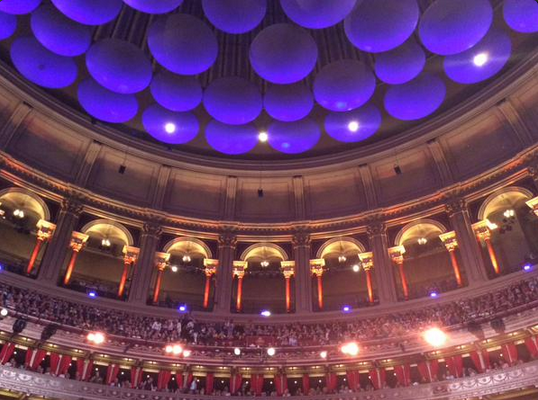
I’m sorry, but Jay-Z? No chance. Glastonbury has a tradition of guitar music […] I’m not having hip-hop at Glastonbury. It’s wrong.
Noel Gallagher, 2008
With every year comes the BBC Proms, and with every year a spate of articles and blogs about the state of the festival. This has been my first season as a classical music blogger, and I have been exposed to a fuller spectrum of debate than before, particularly on Twitter.
I have been struck by some negative reactions to so-called Prom ‘gimmicks’: the Pete Tong Ibiza Prom being a prime example. Debates about maintaining the purity of highly esteemed cultural events are not confined to the classical world, as the quote above demonstrates. Just as Jay-Z’s Glastonbury set was well received, so the Ibiza Prom seems to have been a roaring success.
I’ve also been struck by the fact that rearing its head again is the debate about clapping between movements, which prompted a rather despairing tweet that seemed to chime with a lot of people. Another related complaint seems to be the decision of the BBC to broadcast spoken introductions between movements of pieces on TV, rather than play them all the way through.

Many people fear for the integrity of the Proms for a variety of reasons, including the increasingly uncertain future of the BBC itself. I wanted to put down a few thoughts about the festival and what it says about current classical music culture in the UK.
Firstly, it should go without saying, but we in Britain are extremely fortunate to have the Proms. Ibiza and Doctor Who notwithstanding, it is eight weeks overwhelmingly dedicated to traditional classical music making, in a spectacular venue, widely broadcast across multiple channels, subsidised by a nationwide license fee that helps make tickets very affordable. It’s the kind of tradition that could so easily not have happened, but which has accrued a loyal following from having done so. It has also gained the sort of ‘national cultural treasure’ status which a wider set of people who are not core classical listeners respect, and which will attract them to occasionally pay attention. In that context, complaining that the odd concert is given to music you don’t like kind of seems lacking in perspective.
My response to the announcement of an Ibiza Prom was ‘not my cup of tea, but fair enough’. When I saw the footage and the joyous reactions, I wished I had been curious enough to give it a go. But in any case: if any festival can test the boundaries of inclusiveness, it is surely the Proms. Its huge scale ensures it remains an overwhelmingly classical affair, and the fact that the BBC’s backing means it can afford to risk dabbling in new areas – with no guarantee it will pay off – undoubtedly means that it should. If you think that combining Pete Tong and an orchestra is the wrong kind of experimentation, then you’ve missed the point of experimentation.
As for clapping between movements, the reason that debate is so turgid is that it is unsolvable. You can’t reconcile the desires of those who want reverential silence with those who want to show appreciation after a rousing end of a movement. The two are mutually exclusive and neither inherently right. I default in defence of clappers because I’d rather err on the side of allowing people to behave by instinct rather than by adding social codes to the concert experience, and asking the audience to refrain from showing too much appreciation would feel contrary to the inclusive spirit of the festival. Of much more concern to me, as my tweet above outlines, is how continual debate of such relatively trivial matters make the classical music world look out of touch and a bit ridiculous. Particularly when there are elephants in the room like the fact that the Proms still, in 2015, marginalises music by women.
As for broadcasting commentary between movements, if it is insightful commentary that helps people to engage with the music at these key markers then I think it could be a very good thing indeed. You can certainly argue about how it should be done (cutaway to a talking head or just subtitles during the music?) but those of us who are already well-versed with the classical repertoire should remember that guidance like this could be a gateway of discovery for somebody who isn’t. There is a greater public service broadcasting argument for helping people approach the music rather than simply providing an in-house concert experience for people who are already regular classical listeners.
It’s not that I don’t have my own bugbears. I find the traditions of some Prommers shouting ‘heave, ho’ before a piano concerto embarrassing – the only point of these rituals seems to be to show others that you’re in-the-know. But not being able to have everything your own way is a sign of the festival’s broad appeal. It’s undoubtedly a good thing that the Proms attracts enough people that there are some there who don’t share your values. For example, it still amazes me that there are listeners who are genuinely upset when there isn’t enough Mozart. I wonder how they’d react to my idea of doing an experimental Proms season where no composer gets more than one work performed…
My main concerns with the Proms are about how much more it could be doing. For new music, for music by women, for non-Western classical music and for the richness of our home-grown heritage, for collaborations across art forms. In many, many ways it does a fantastic job already, but it’s absolutely right that we demand it aim still higher.
But what is also surely right is that we are not entitled to a license-fee funded festival of this scale reserved for a purist ‘Temple of Music’ experience. It needs to be a broad church that engages widely and in a variety of ways. My personal ideal for the Proms is to have more risk, more diversity, more creativity about realising the potential of classical music to be relevant to everyone, while exploring interesting connections. Of course it should retain its remit as a festival primarily of classical music, but having diverse appeal within that remit is, in my view, the best way for to be defended against any future squeezes on BBC spending.
Corymbus has moved! You can read this post on the new site here
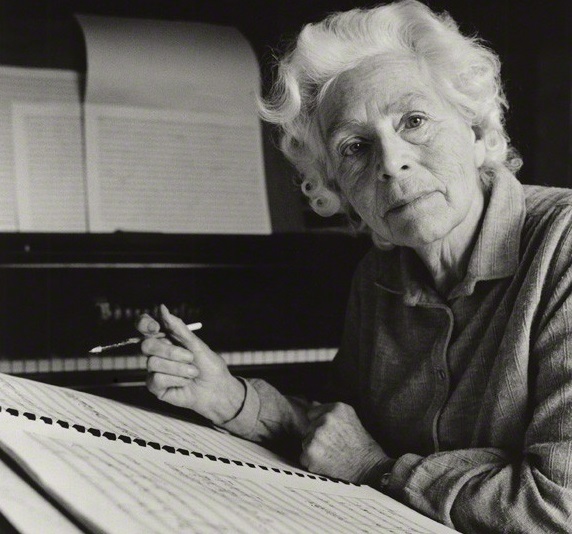
Elizabeth Maconchy by Suzie Maeder, bromide fibre print, 1980
Last year I wrote about my embarrassing ignorance of music by women composers, and my vow to educate myself. I mentioned that even a short time spent searching YouTube had revealed lots of surprising and brilliant classical music by women, and that the string quartets of Elizabeth Maconchy (1907-94) had immediately stood out as revelatory. Now I want to return to these works with a blog of their own.
The YouTube videos came from what is, shockingly, the only commercial recording set of these 13 quartets yet released. While listening, I was immediately struck by Maconchy’s compelling writing; here was a razor-sharp musical intelligence completely inhabiting a musical medium. In fact it is remarkable how easy it is in these works to forget that you are listening to a string quartet. The instrumentation is totally synthesised into the musical message – Maconchy plays to the natural expressive strengths of the instruments without drawing attention to their limitations with excessive demands.
The first movement of her second quartet, composed at age 29, demonstrates her mastery. It builds from a low drone, the parts twisting and turning around each other with gathering momentum like the evolving shapes of a bonfire taking hold. No instrument takes centre stage; instead the parts work together in a tightly knit argument of motifs, ebbing and flowing in fascinating ways while effortlessly driving a sense of drama. Maconchy always keeps you guessing, resisting any sense of resolution until the final tentative major chord. I find it utterly compelling and – if perhaps unconventionally – beautiful.
In 2007 the On An Overgrown Path blog posted an insightful and lovingly-written advocacy of Maconchy and her quartets, which I encourage you to read. The author describes the ‘conundrum’ that she poses: ‘vital and astringent music combined with an unassuming personality’. There is certainly an enigma to these works, a fascination deriving from the combination of their expressive qualities with a restless abstraction. Maconchy’s notes to her sixth quartet offers an insight into her approach:
Writing music, like all creative art, is the impassioned pursuit of an idea […] in my view everything extraneous to the pursuit of this central idea must be rigorously excluded – scrapped.
The thirteen quartets span over fifty years of composition. The remnants of traditional tonality in her second quartet do not survive into her late works, which are more brutal in their dissonance and often more reticent in their textures. Her ’impassioned pursuit of an idea’ seems to have given way to a landscape which is much more fractured and complex. This evolution was not confined to her string quartets, as Maconchy’s daughter Nicola LeFanu – a composer in her own right – described in these comprehensive biographical notes about her mother:
She had left behind a harmony based on familiar tonal or modal hierarchies, for a language that is more exploratory. Her melodies became more expansive and her sensitivity to timbre, notable from her earliest work, was strengthened […].
It’s a considerable change of style, but Maconchy was perhaps moving with the times: the eleventh quartet was composed in 1976, and has an uncompromising strangeness, a resistance to being easily understood which to this day seems to be a default setting in so much new classical music (contrast this to the serenely beautiful late quartet of Rubbra I recently wrote about, which was composed the following year).
Sadly, the severe neglect of Maconchy’s works that On An Overgrown Path highlighted in 2007 has barely changed 8 years on, with performances few and far between. Yet when she is performed, reactions tends to be positive: her two chamber operas The Sofa and The Departure got aired in that centenary year to good reviews, her third quartet made an appearance at the 2013 Proms, and another quartet outing in 2012 had one unsuspecting tweeter summing up my reaction to hearing her music for the first time.

In considering Maconchy’s neglect, perhaps a useful comparison is Barbara Hepworth (1903-1975). Just four years older than Maconchy, she excelled in another abstract form: sculpture. I’m a music graduate, yet I was aware of Hepworth’s work long before I was aware of Maconchy. Why? Because I saw her sculptures in galleries. I didn’t need an art degree to pick up a sense that she is considered important – Britain’s cultural establishment told me so. As if to illustrate my point, there is even a whole exhibition dedicated to her work at Tate Britain right now.
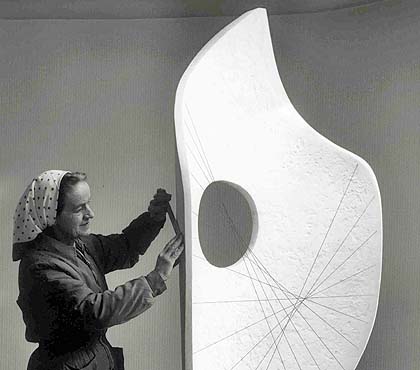
Barbara Hepworth holding a file with the plaster for Curved Form (Bryher II) (November 1961) © Bowness, Hepworth Estate
There are limitations to this comparison of course, but it nonetheless illustrates something. Tate Britain has a free collection in central London dedicated to Britain’s heritage in visual art. A public institution of equivalent stature to promote Britain’s contribution to classical music is both sorely lacking and sorely needed. (Maconchy was Irish, though having lived and worked for most of her life in England was undoubtedly part of Britain’s musical landscape). I’m not sure what form such an institution should take. But as I argued on St. George’s Day, no one will look after our music if we don’t.
And inevitably, Maconchy’s marginal status raises another question. Does classical music fail its women of the past even more than other art forms? To me it certainly looks like it. Radio 3’s long overdue Women’s Day showed how much fabulous music there is by historic women composers, yet this is not remotely reflected in concerts. It’s partly bound up in the bigger problem of our repertoire being too narrow across the board, and as such, it’s hard to unpick how much the neglect of someone like Maconchy is down to her being a woman, or her just not yet being a bankable name. But it’s certainly interesting that all the bankable names still seem to be men.
So what does it take for a composer like Maconchy get the same kudos as Hepworth? For all the disruptive potential of social media and blogs, it’s still establishment institutions and the mainstream media that hold the most sway over the public’s sense of what, or who, is important. Their decisions can significantly change perceptions – the BBC’s recent decision to give the women’s football world cup much more prominent coverage is a case in point.
But even without institutional support, it does surprise me that more string quartets haven’t seized on Maconchy’s works. The first seven quartets in particular should hold no fear for audiences fed on a seemingly limitless supply of Shostakovich. And the more I listen to Maconchy, the more fascinating and brilliant she becomes: respecting the intelligence of the listener without ever trespassing on his or her patience, never striving for the monumental, but producing superbly crafted music of real integrity. Her music doesn’t need a gender gap to justify being championed, but the fact that we have one – one so stark and persistent – surely makes not doing so unjustifiable.
I’ve dished out a fair bit of criticism of the BBC Proms on this blog before, in relation to composers whose works they tend to neglect. But nonetheless it is a festival I love to attend, and I generally do so every year. So in the spirit of fairness I have written for Classical Diary on why I love the tradition of ‘Promming’, and why I think it is in some respects a superior way to listen to live music. You can read my post here.
Frances Wilson very kindly asked me to write a guest post for her excellent blog, The Cross-Eyed Pianist, on any musical subject. I gladly accepted, and have put together some thoughts exploring the theme that made me start Corymbus – the frustration of such much brilliant classical music being neglected on the concert platform and the radio airwaves. You can read my guest post, in which I argue that our narrow repertoire is holding classical music back, here.

Today is the birthday of composer Edmund Rubbra (1901-86). In January I wrote an extensive blog post about Rubbra’s music, using his eleventh symphony as an example of why I love his work. But given the sheer scale of Rubbra’s neglect, I wanted to take the opportunity of his birthday to mention him again.
I recently re-discovered the fantastic speech that comic writer and lifelong classical listener Armando Iannucci gave to the Royal Philharmonic Society in 2006, in which he passionately argued we should all talk more about what music means to us. This blogger obviously could not agree more. But in it Iannucci also related his discovery of Rubbra’s music, despite it having fallen out of fashion:
When I first heard Rubbra, was I unaware that his music, along with the music of many English symphonists of the Fifties, Sixties and Seventies, had been critically banished from the airwaves and concert halls because they were deemed embarrassingly traditional. So I had no idea I wasn’t meant to like it.
Sadly, that banishment has lasted for a long time. But as for being embarrassingly traditional, I think the perfect response to such a superficial judgement came from Rubbra himself:
It is not musical style that matters, but the thought behind the style; it is the stature of the thinking that gives music substance.
I include below two examples of the stature of Rubbra’s thinking: the first movement of his wonderful piano concerto that gave this blog its botanical name, and one of my favourite of his late works: the fourth string quartet. The latter piece, like the eleventh symphony, shows the fascinating evolution that his music underwent in his later years, becoming at the same time more condensed and more liberated. Its soft and serenely dignified ending is also, in my view, one of the most moving passages in his whole output.
Should that not be enough, these two pieces also feature on an introductory playlist for Rubbra’s music that I have compiled from what is available on YouTube, which can be found here. And as a final thought as to why I think this man’s music matters so much, I can only repeat what I said in my previous blog:
I maintain hope that Rubbra’s time will come. There is too much quality in his work, in its craftsmanship and its distinctive voice, for it to forever remain in the shadows. Even if you don’t share Rubbra’s religious faith (and I don’t) the essential goodness in his music surely has something important to say to our cynical times: its patient optimism, beautiful organic patterning and deeply felt spirituality are a welcome antidote to much of modern life.
So Happy Birthday, Edmund Rubbra. Here’s hoping you won’t have too many more before you get the recognition you deserve.
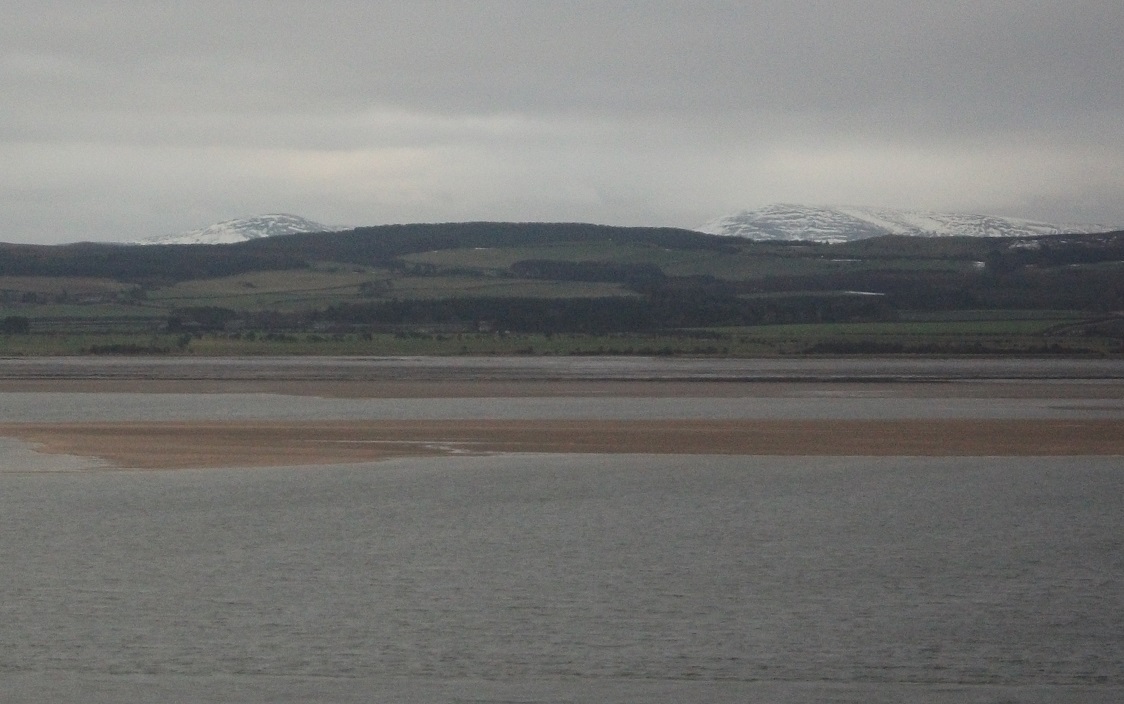
The Cheviot Hills of Northumberland, seen from the island of Lindisfarne.
Last year, the Guardian columnist and environmental writer George Monbiot tweeted that he’d been struck by the discovery of Rautavaara’s Cantus Arcticus – a ‘Concerto for Birds and Orchestra’, which uses recordings of birds living near the arctic circle in the composer’s native Finland.
Having read Monbiot’s book Feral: Rewilding the Land, Sea and Human Life, it’s not hard to see why Cantus Arcticus appealed. He writes with an infectious enthusiasm for nature, combining deep knowledge with a child-like sense of wonder. Feral is a passionate polemic for the concept of ‘rewilding’: allowing spaces both on land and sea for natural ecosystems to grow unhindered, with the reintroduction of native species previously wiped out.
The magic of Cantus Arcticus is its vivid sense of this kind of ecosystem; the unfamiliarity of a place that has not been cut up and cultivated to service human needs. Chaotically flying woodwind lines accompany the calling of vast flocks of birds, and the music blossoms into a broad sweeping melody, suggesting the grandeur of wide Arctic spaces. I am not normally a great lover of taped samples in classical music, but there is a kind of alchemy in the way the recordings of birds interact with Rautavaara’s orchestral writing that makes it powerfully compelling.
There is, of course, a long tradition of music written about man’s awe in the face of natural wonders, from Mendelssohn’s Hebrides Overture to Strauss Alpine Symphony. The Alps also played a role in the poetic tradition of the Sublime, where nature’s magnitude inspired a sense of fear and horror. This fear was perhaps an acknowledgement of our ultimate irrelevance to the vast age of the earth, and the limits of our power to fully understand and control it.
But it is not just the colossal that can terrify; in nature the small-scale can equally baffle and disturb. Last autumn I was walking on Greenham Common in Berkshire when I was astonished to come across a gorse bush almost entirely cocooned in what looked like an enormous spider web, and covered in what appeared to be a dense cluster of tiny red eggs. I later learned they were in fact a colony of gorse spider mites. Each only half a millimetre long, they had performed an impossible feat of collective construction, with a result that was fascinating but creepily unreal.
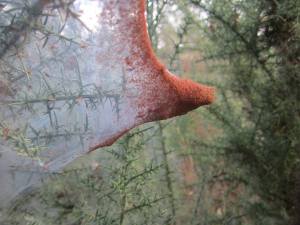
Nature in its unmanaged state seems to be a double-edged sword: it can enchant us with its richness, but this very complexity, when married to phenomenal powers of growth, scares us too. The idea of the overgrown as dangerously alluring was explored in Shakespeare’s A Midsummer Night’s Dream, a passage from which inspired an orchestral tone poem by Scottish composer John McEwen (1868-1948).
I know a bank where the wild thyme blows,
Where oxlips and the nodding violet grows,
Quite over-canopied with luscious woodbine,
With sweet musk-roses and with eglantine:
There sleeps Titania sometime of the night,
Lull’d in these flowers with dances and delight;
And there the snake throws her enamell’d skin,
Weed wide enough to wrap a fairy in…
Shakespeare’s setting may be fantastical, but the underlying fears are very real. The ‘snake in the grass’ is of course a proverbial symbol of hidden danger, but it is where he invokes ‘weed’ that we see the human distaste of what is not useful to us having an agenda of its own: part of a lexicon of hostility that also includes ‘pest’ and ‘vermin’. When nature’s fecundity does not conform to our needs, we show a strong disliking for it.
McEwen’s Where the Wild Thyme Blows opens with a softly ambiguous rising string figure and plaintive calls on bassoon, the harmony eerily static, yet dissonant enough to create a feeling of creeping unfamiliarity. The use of atmospheric orchestration and relatively restrained expression throughout suggests a landscape that fascinates from afar, but is best not explored in depth.
Undoubtedly, there are sometimes good reasons to fear the wild. The dark primordial woods that once blanketed the UK found their way into our oldest folk stories and fairy tales as places of danger, and these would have contained some of the most intimidating animals that our ancestors encountered – before they hunted them to extinction. A few months ago I wrote about Arnold Bax, a composer fascinated by human and natural wildness: both of the pagan past, and the tempestuous Atlantic coastlines he loved to frequent. His third symphony, perhaps his most inspired creation, seems to evoke a world of primeval savagery and glistening, unspoilt landscapes. Bax was a late-Romantic with a gift for sweeping melody, but in the symphony’s opening he almost abandons conventional tonality altogether, taking an atonal motif in the bassoon and building it over layers in the woodwinds one by one. In doing so he sets a scene of something irrational, overgrown, and unwelcoming: a dense forest of strange voices.
Breaking down the structure of tonality is undoubtedly an effective means of expressing a lack of human control. A good example of taking this principle to its logical conclusion is Gondwana by the French composer Tristan Murail (b. 1947). Gondwana was a super-continent that existed 200 million years ago, a time of dinosaurs and other unfamiliar beasts. In Tom Service’s Guardian blog he describes Murail’s ‘spectralist’ approach to composition, rooted in the physicality of sound itself and the colours of its overtones. Though modern in its means, this dazzlingly strange music helps us make an imaginative leap into a world that existed long before the first human heartbeat.
Sadly, you don’t have to travel back as far as Gondwana to find amazing lost ecosystems. Feral describes how those English hills in my header image would once been home to wolves, lynx, bears, elk, and beavers – even bison, hippos and elephants. And we should all be alarmed, because we are still living in a time of huge species loss and habitat destruction, something seen acutely in Rautavaara’s Arctic, which scientists recently warned is entering into a new phase of its existence. The question of how human prosperity can be achieved without catastrophic climate change and ever-increasing depletion of ecosystems is one of the most pressing issues of our time, and in this context, engaging ourselves with the natural world is a huge moral imperative for all of us. I believe the arts can, and should, have a big role to play in this.
But Feral also has an inspiring message. Monbiot’s knowledge, curiosity and sense of adventure in wild places (he kayaks alone several miles into Cardigan Bay to watch dolphins) demonstrates the possibility of a different way of living, one more in tune with our hunter-gatherer past in its awareness of what surrounds us, and its physical interaction with the land and sea.
I haven’t bought a kayak just yet, but since reading Feral I’ve started something I’ve meant to do for a long time: learn about foraging. And I’ve quickly found that once you start the practice of observation, your experience of nature becomes much more meaningful. We may not have wild bears and bison in the UK any more, but we still have amazing riches right on our doorsteps, from the spooky architecture of spider mites to this unexpectedly beautiful ‘Amethyst Deceiver’ mushroom I found last year.
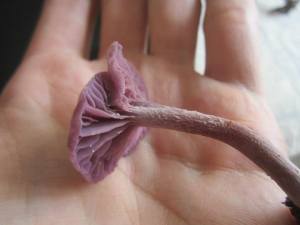
This blog is about discovering unjustly neglected music, but there is a strong parallel to discovering nature too. In both cases the question is: how often do we look closely at what we don’t already know? Because with enough time and curiosity, we can all enjoy the benefits of beginning to rewild ourselves.
And finally, some good news. With beavers recently reintroduced in Devon, and applications made to reintroduce the lynx in the UK too, our world could soon be getting that little bit more fascinating and colourful right where we are.
 corymbus.co.uk
You must be logged in to post a comment.