The Legends Of Jubal

Where did music come from? Who first discovered how to sing a note, or beat a rhythm? If you’ve ever pondered these questions, you probably wouldn’t expect to find a firm answer. Music has been around for as long as we know, across all civilisations – so we must assume it arose somewhere in deep evolutionary history, possibly even before our ancient ancestors developed language.

At least, that’s a modern way of looking at the question. But in times past, music had its own creation myths. One of them can be found in Musicks Empire by the 17th-century poet Andrew Marvell, which imagines the emergence of music from primordial origins:

First was the World as one great Cymbal made,
Where Jarring Windes to infant Nature plaid.
All Musick was a solitary sound,
To hollow Rocks and murm’ring Fountains bound.

 Jubal first made the wilder Notes agree;
And Jubal tun’d Musicks Jubilee:
He call’d the Ecchoes from their sullen Cell,
And built the Organs City where they dwell […]

These lines were my first encounter with the name Jubal. He’s a character in the Bible, but an extremely minor one – he’s mentioned only once as a descendant of Cain, where he’s described as ‘the father of all such as handle the harp and organ’ (King James Version).

So Jubal, we’re told, was the world’s first instrumentalist. But Marvell’s poem interprets him as more than this, someone who discovered musical principles – he ‘made the wilder notes agree’, found harmony among the ‘jarring Windes’.

Of course, the idea of one man inventing music has fallen out of favour in the modern era. But Jubal’s stamp of Biblical approval once carried a lot of weight. For centuries he turned up in art, literature, and theoretical texts relating to music – despite him being little more than an Old Testament footnote.

Nonetheless, the thinness of his personal story poses a challenge. How or why he fathered music is left unsaid. But Musicks Empire shows that ambiguity is not always a disadvantage – it makes Jubal something of a blank canvas on which to project imagined musical origins.

So what about his connection to Cain, the son of Adam and Eve who famously murdered his brother Abel? This context is worth considering. The story is covered in Chapter 4 of Genesis, just after the expulsion of Cain’s parents from the Garden of Eden.

Cain slays Abel, out of envy that God has favoured his offering. Discovering this, God declares that he is ‘cursed from the earth’. Cain moves to the land of Nod, saying ‘from thy face I will be hid’. There he fathers his descendants.

Several generations down we get to Lamech, father of Jubal. But Jubal also has a brother Jabal, who was the first cattle farmer, and a half brother Tubal-cain, who was the first blacksmith.

Much remains mysterious. What significance is there to the three professions of musician, cowherd, blacksmith? And what should we make of their ancestral connection to a murderer? A further detail at the end of the chapter is even more elusive. Lamech also confesses to a killing – ‘I have slain a man to my wounding, and a young man to my hurt’. The victim is not named.

One early interpretation of this chapter was made by Philo of Alexandria. He argued that Cain was an allegory of how the soul can willingly move away from God, which in his view leads to instability. He writes that the names of his descendants reflect this – Jubal means one who ‘inclines’ in different directions, just as music has varying articulations.

But for writers on music, Jubal had rivals for his crown, who came with their own stories. From Greek mythology we have Hermes, who used a tortoise shell to fashion the first lyre. And from ancient science there’s Pythagoras, credited with discovering the numerical proportions of harmony. His own life was shrouded in legend too.

Authors such as Boethius spread a tale of how the philosopher heard blacksmiths hammering one day. He noticed the hammers made different notes as they struck the anvil, so Pythagoras went and weighed them. He found the pitches were in proportion to their weight. This is in fact bad science – pitch does not relate to hammer weight like the lengths of a vibrating string. But an enduring story was forged, and for many music theorists it proved irresistible.

What’s more, a door was left open here for Jubal too. His own connection to a blacksmith – his half-brother Tubal-cain – meant that he could join this anvil chorus through a degree of conflation. Thanks to Pythagoras, the two crafts were connected.

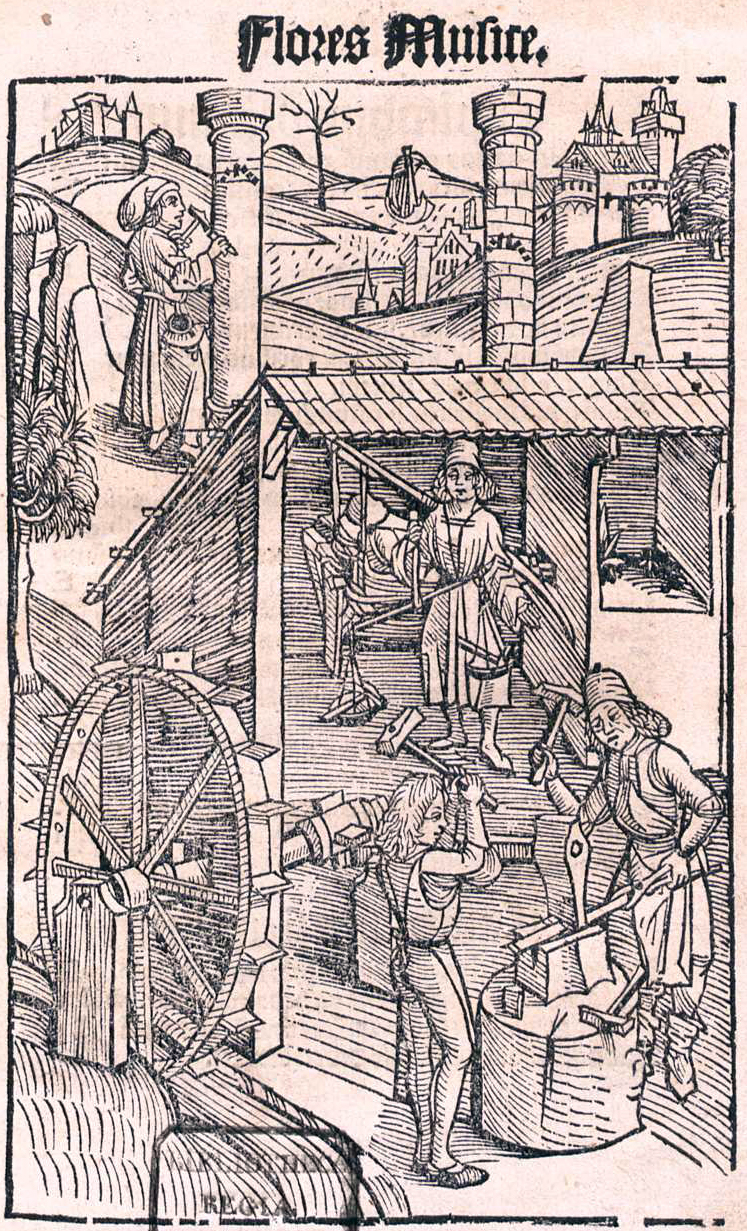
An illustration from a 1492 edition of Franchino Gaffurio’s Theorica musice shows Jubal overseeing six blacksmiths, while Pythagoras and Philolaus consort with a variety of instruments. Meanwhile, a fine engraving from another treatise offers an intriguing new detail to the smithy scene. Against a backdrop of rolling hills, a man stands next to two columns, as if from a ruined temple. He has a chisel in his hand, and appears to be carving musical notes into them.

An explanation lies in a Medieval volume known as The Chronicles of Jerahmeel. It gives a version of the Jubal story in which our hero hears about prophecies of flood and fire, and takes action to ensure the secrets of music can survive those perils. So he inscribes his knowledge onto a column made of marble, and another made of brick, so that in the case of either disaster one would remain unharmed.

But the double-act of Jubal and Tubal-cain would take on a whole new significance in the world of Medieval theology. It came through a tradition known as ‘typology’ – the comparison of events in the Old and New Testaments, in which details from the Old were seen to ‘prefigure’ those in the New. 

One of the most popular typological works of the Middle Ages was the Speculum Humanae Salvationis, or ‘Mirror of Human Salvation’. In this text, our brothers are given the prestigious honour of prefiguring the Crucifixion itself. Tubal-cain is shown foreshadowing the nails hammered into Jesus’s body, while Christ’s prayer for his enemies – ‘forgive them for they know not what they do’ – is compared to a beautiful melody, hence Jubal. 

To modern eyes, these connections may seem tenuous, but to the Medieval believer they must have helped to put old (and sometimes ambiguous) Jewish scripture into a more comfortably Christian context. And through the wide dissemination of this work came a host of different illustrations. Most commonly, Jubal is shown clutching a stringed instrument in the smithy – it’s worth remembering here that taut musical strings have sometimes been compared to the tortured body of Christ too.

Eventually, for music theorists and historians, the idea of a legendary founder of music lost its appeal. In the early 18th century we can see Roger North giving it short shrift:

[…] we have poetick relations of dryed nerves in tortoise shells, smith’s hammers, and practioners, […] But I am perswaded that, notwithstanding all these pretensions, Musick had an higher originall, and that is the use of voices, and language among men.

But for those of a more literary bent, the story still resonated. Rudyard Kipling’s short poem about Jubal and Tubal-cain cast the brothers as two archetypes: those of artistic dreams and those of rugged action, who hold each other in antipathy:

Jubal sang of the Wrath of God
And the curse of thistle and thorn—
But Tubal got him a pointed rod,
And scrabbled the earth for corn.
Old—old as that early mould,
Young as the sprouting grain—
Yearly green is the strife between
Jubal and Tubal Cain […]

This short, punchy poem stands in stark contrast to a much longer one by George Eliot. The Legend of Jubal is an extraordinary and beautiful expansion of this slim character onto an epic scale, filled with sparkling scenic detail. Eliot makes Jubal a questing artist, who after inventing music sets off to roam the world in inspiration for new songs, spreading melody as he goes. He returns home after many years to find his name is now sung in worship, but his aged face is no longer recognised. Taken as a sacrilegious imposter by those who consider him a god, he is beaten to death.

It’s a tragic twist for our hero. But The Legend of Jubal was composed in the shadow of death – as Eliot wrote it, the son of her long-term partner was dying of tuberculosis. And it’s easy to forget that Genesis 4 is really about death too. Abel is not only the world’s first murder victim, he’s the first ever person to die. His demise continues the loss of innocence that came with the expulsion from Eden. 

And while Cain’s descendants were all born after the murder of Abel, another death plays a pivotal role in this poem. Eliot cleverly draws upon the mysterious verse of Lamech’s confession.

At the beginning, Cain’s tribe live an idyllic life with the legendary longevities described in Genesis – their father walks among them, a ‘sinewy man embrowned by centuries’. But when Lamech accidentally kills a boy of his own with a hurled stone, everything changes:

Death was now lord of Life, and at his word
Time, vague as air before, new terrors stirred,
With measured wing now audibly arose
Throbbing through all things to some unknown close.
Now glad Content by clutching Haste was torn,
And Work grew eager, and Device was born.

After this second discovery of mortality, Eliot describes the founding of the three professions, as Lamech’s sons, newly aware of time, hurl themselves into industry. And music, after all, is a way of measuring time – its rise and fall it prefigures our own ‘unknown close’. But, like Kipling, Eliot characterises Jubal differently from his more physical siblings:

[…] Jubal had a frame
Fashioned to finer senses, which became
A yearning for some hidden soul of things,
Some outward touch complete on inner springs
That vaguely moving bred a lonely pain […]

Some biographers have interpreted Jubal as reflecting Eliot’s anxieties about the writer’s life. The poem certainly shows that the artist’s lot is fraught with the risk of rejection. But with it too is the hope that you may create something lasting. As Jubal dies, he sees the face of an angel, who consoles him ‘This was thy lot, to feel, create, bestow / And that immeasurable life to know’.

Over the centuries, Jubal has shifted into many shapes, and adopted many forms. He has been a usefully vague placeholder for the dim origins of music which are forever lost in the mists of time. Eliot’s tragic hero is perhaps the most keenly felt manifestation of this long tradition, who speaks like a prophet in verse that has its own music:

The song shall spread and swell as rivers do,
And I will teach our youth with skill to woo
This living lyre, to know its secret will;
Its fine division of the good and ill.
So shall men call me sire of harmony,
And where great Song is, there my life shall be.


My blogs are powered by caffeine. So if you enjoyed this one, a cheap but meaningful way to support my writing is to buy me a coffee on PayPal. For a monthly donation, subscribe to my Patreon


Pachelbel’s Hexachord

The name of Johann Pachelbel is forever associated with one piece: his indefatigable Canon in D. A mainstay of both the wedding and call centre circuits, its relentlessly sunny disposition as it cycles through its famous ground bass becomes either charming or grating, depending on who you ask, and how often they’ve had to listen to it.

Despite the Canon’s overwhelming presence in Pachelbel’s reputation, I’ve recently been exploring a much more intriguing work: his 1699 keyboard music publication Hexachordum Apollinis. The title refers to the strings of Apollo’s lyre, and the book features variations on original ‘arias’ in keys which run in a hexachord. These are pleasant and elegant pieces, and all but one are in minor modes, creating more pensive shades than the shiny surfaces of his most famous work.

There is, however, an irregularity in Pachelbel’s scheme. The keys of the first five pieces are D minor, E minor, F major, G minor, A minor. To complete the hexachord the final aria should be in B flat, but here he takes a swerve: he uses the B flat key signature, but the music is written out in F minor. It’s also the only piece with a subtitle – Sebaldina – presumably a reference to St. Sebaldus church in Nuremburg, where Pachelbel was employed.

The reasons for such departures are unclear. And the strangeness does not end there, either. The Hexachordum includes a ‘Kabbala’ page, illustrating a numerological scheme that links Pachelbel’s name to the year of publication 1699, by adding together numbers associated with the following letters:

JOHANNES PACHELBELIVS ORGANISTA NORIBERGHENSIVM.

See the full ‘Kabbala’ page here.

Even in Pachelbel’s day, the Jewish mystical tradition of Kabbala had long been of esoteric interest among certain Western Christian intellectuals. Whatever the reason for its inclusion here, it hints at Pachelbel being a far more interesting figure than his reputation as a Baroque one-hit wonder would suggest.

There are plenty of recordings of the Hexachordum to chose from, whether on stringed keyboard instruments or the organ. In the video below, Wim Winters performs the fourth aria on a clavichord.

Or, if you want something a bit different, you can listen to a synthesised version of the same aria by Muscle Pony.

My blogs are powered by caffeine. So if you enjoyed this one, a cheap but meaningful way to support my writing is to buy me a coffee on PayPal. For a monthly donation, subscribe to my Patreon

Enter Spring

It’s possibly my favourite time of year. The trees are in leaf, the hedgerows in flower, the air is filled with birdsong, the days are stretching out. It’s warm but not too hot. Summer is still to come.

On top of all that, Newbury Spring Festival has started. I’m tempted by various events on their programme this year. Most of the concerts take place in Newbury itself, though St. Martin’s East Woodhay – a lovely rural church I wrote about last year – is hosting Voces8. Sadly for me, it’s already sold out.

So instead I’ve looked at attending some of the shorter lunchtime recitals. I noticed these are being held in the Corn Exchange – the main theatre in the town. Which makes sense, but…I have a problem here. This is a general point, not aimed at Newbury Spring Festival in particular, who put on a fabulous programme and may have any number of constraints on the timing and venues for their concerts. But still, I’d be interested to know if anybody else feels the same way.

The thing is, I adore natural light. I just love it. The surge in its levels during the spring – even on a cloudy day – is a major lift to my mood. I always like to be near windows for ambient light. So the thought of spending an hour of a spring lunchtime – prime solar real estate! – in a windowless, artificially lit hall is genuinely off-putting for me. I’d much rather hear it in a church. On one extreme occasion, when I heard a recital in a very dark hall during the day, the sudden drop in light levels made me incredibly drowsy. In winter, when it’s always darker, I probably wouldn’t mind as much, though I’d still opt for music in a space with windows if I had the choice.

For an evening concert, of course, it’s not an issue. Though that’s not to say that the gloriously drawn-out twilights of this time of year can’t add something special. When I heard a concert at St. Martin’s a few years ago, the fading May light behind the freshly-green Hampshire Downs added real magic to the experience. In the same way, the gradually darkening sky above Shakespeare’s Globe creates a wonderful atmosphere for drama during the summer season.

Of course, the ideal of the hermetically sealed concert hall has its logic – if you let in light, external noise may follow. This is true of London’s beautiful old churches, where I’ve enjoyed many lunchtime recitals that featured the occasional cameo from a nearby police car. In the Globe, aeroplanes are a common interruption, and the actors sometimes ad-lib at their passing over for comic effect.

Nonetheless the fact remains: at the time of year when I’m stocking up on Vitamin D, I don’t want to miss an hour of daylight. Maybe this makes me unusual. But I’d love to let the spring back into spring music.

Finding The Raga

When I first picked up Finding the Raga by Indian novelist Amit Chaudhuri, I flicked through the 250 pages, set in a fairly large typeface, and thought it would be a light read.

Such hubris.

Having now finished, I feel I need to immediately re-read it to fully absorb the intricate observations held within Chaudhuri’s seemingly simple prose. Finding the Raga is one of the most interesting books on music I’ve ever read – and that’s because it’s only partly about music. It’s a free-flowing memoir about a life spent in India and Britain, but also an exploration of Hindustani classical music from a man who is a committed practitioner of the Raga tradition – he sings one every morning. Along the way, Chaudhuri considers philosophy, literature, history,  cinema, his teenage love of Western singer-songwriters, and his parents’ Beethoven records.

I started this book with some interest in Indian music, mostly explored through the Darbar Festival YouTube channel, but very little technical knowledge. Perhaps inevitably, the unfamiliar musical terminology here doesn’t all ‘go in’ on a single reading, but it leaves a strong impression of the sophistication of Indian music and its diverse strands.

Chaudhuri is refreshingly frank about how strange classical music can be to the uninitiated – both the Indian and European varieties, which are equally minority pursuits. He thinks perceptively about what music is and how it is culturally determined. And some of his most interesting passages take into account the meaning of silence, noise, and listening in British and Indian culture.

For these last reasons especially, I would urge anyone who has been brought up with a Western musical education to read Finding the Raga. It’s a brilliant read in its own right, but it’s also a useful corrective to the world-flattening ‘Great Composer’ narratives which are still so prevalent in our musical discourse. This book will expand your understanding of what music can be. I bought my copy on Hive.

My blogs are powered by caffeine. So if you enjoyed this one, a cheap but meaningful way to support my writing is to buy me a coffee on PayPal. For a monthly donation, subscribe to my Patreon

Garlic Mustard

There are some things in the natural world that seem to pass you by for years, until, by some unknown shift in awareness, you begin to notice them. Alliaria petiolata is a very common spring wild plant in roadside verges around here, and must have been present in my childhood, but I only began to notice it a few years ago. It’s common name is garlic mustard, after the taste and smell of its leaves, which are edible.

Wild garlic (Allium Ursinum) is normally the thing that gets foragers most excited, and sends them skipping into the woods each spring in derangement for pesto. But garlic mustard might also be a workable substitute. I tried a leaf yesterday morning, plucked a safe distance from the polluted road. It was, undeniably, garlicky.

The plant is native to Europe and Asia, but in the USA it has caused consternation as an invasive species. Such is its colonial spread that the New York Times dubbed it ‘evil, invasive, delicious’, and encouraged good eco-citizens not just to eat it, but pull it up, roots and all.

I feel the purely culinary name is unfair to the elegance of this plant. It’s in its element right now, shooting up from shady verges into the lengthening, strengthening spring sunlight. As Matthew Arnold put it, ‘soon will the high Midsummer pomps come on’ – the verges stuffed with a fluffy riot of cow parsley. But for now garlic mustard steals the roadshow in the dappled verge-light, sometimes guarding an inner sea of woodland bluebells. It’s joyful verticality and empty space, an impossibly thin catwalk model turned plate-spinning waitress. The leaves are arranged around the stem to avoid shade from the one above, spiralling down and broadening, each something like a serrated heart, or the outline of an elephant’s head – and just as wrinkled.

My blogs are powered by caffeine. So if you enjoyed this one, a cheap but meaningful way to support my writing is to buy me a coffee on PayPal. For a monthly donation, subscribe to my Patreon

The Thomas Browne Affair

Last year I wrote about Kenneth Leighton’s Symphony No. 3, Laudes Musicae. As the Latin title suggests, it’s a work which sets words in praise of music, and in the first movement the tenor soloist sings a section of prose by the 17th-century philosopher Sir Thomas Browne. This passage is a defence of music launched against the music-sceptical Puritans of Browne’s time, in which he draws on Pythagorean ideas of cosmic order and harmony. But he also suggests that more mysterious forces are at work:

there is something in it of Divinity more than the eare discovers. It is an Hieroglyphicall and shadowed lesson of the whole world […] 

I recently finished reading Hugh Aldersey-Williams’ 2015 book The Adventures of Sir Thomas Browne in the 21st Century. It’s an engaging trip through the life and ideas of a man of huge learning and boundless curiosity. As a fellow writer and Norwich resident – where Browne spent most of his life – Aldersey-Williams evidently feels a strong affinity for his subject, and offers reflections on Browne’s legacy for modern times.

Browne was a physician by trade, but he wrote on a startling variety of topics. The passage above is a short section from his essay Religion Medici (‘Religion of a physician’) which wrestles with questions of science and faith. But he also compiled an encylcopedia of popular errors (Psuedodoxia Epidemica), catalogued the natural history of Norfolk, meditated on death and burial rites (Urn Burial), and speculated to esoteric length on the mystical significance of the quincunx pattern (The Garden of Cyrus).

Aldersey-Williams’s book is somewhat idiosyncratic, mirroring Browne’s eclectic interests. ‘He is in many ways gloriously irrelevant’, he writes, an emblem of an intellectual age before the emergence of the ‘two cultures’ views of arts and sciences, a bifurcation which has ‘bedevilled British education and academia’. Browne moved effortlessly between these worlds, sometimes in the same sentence. ‘The civility of Browne’s day that allowed natural philosophers to engage in dialogue with other scholars of all kinds has been superseded by a grammar largely private to science,’ he notes with regret. He showed humility in the face of mystery, which the author contrasts to the often shrill and self-righteous rationalism emanating from some modern celebrity atheists and science communicators.

Though Browne has not accrued the modern fame of a Newton, he has a disparate but loyal following that sees him pop up in surprising places – I recently found a reference to him while reading the short stories of Borges, for example. As a scientist with mystical tendencies and the ability to turn a memorable phrase, his broad fan-base is understandable, because you can discover him from so many angles. He also seems a likeable character, and a beacon of tolerance for his time, even if he sometimes got things wrong. Most troublingly, Browne’s willingness to consider the possibility of demonic possession when he was called as an expert to a Suffolk witchcraft trial may have helped – or at least not prevented – two accused women being hanged. This period is fascinating, but you wouldn’t want to live there.

A while ago, I picked up Basil Willey’s 1934 book The Seventeenth-Century Background in a charity shop. It has a superb chapter on Browne, and his ‘marvelling temper’. He likens him to a ‘Janus’:

Perhaps no writer is more truly representative of the double-faced age in which he lived, an age half scientific and half magical, half sceptical and half credulous […]

Willey identifies Browne as a ‘metaphysical’: one who moved freely between spheres of thought and feeling, never ‘finally committed’ to one place. The description of music as ‘an Hieroglyphicall and shadowed lesson of the whole world’ is typical of his fondness for the ‘reduplicated phrase’ – an generous linguistic habit in which a classical or hifalutin word (Hieroglyphicall) is balanced against a more familiar one (shadowed).

Willey muses that ‘it is more than likely that Browne was sensitive to the Janus-like quality of the English language itself, half Latin and half Saxon’. His ear for language was no doubt a factor in perhaps his most tangible and impressive legacy: the coinage of a large number of words that we use every day. Among them are ‘hallucination’, ‘medical’, ‘electricity’, ‘deductive’, and ‘ferocious’. Aldersey-Williams sprinkles informative asides about these words along the way of his book, in sometimes lengthy footnotes.

The composer William Alwyn (1905-85) was a lifelong reader of Browne. He named his Symphony no. 5 Hydriotaphia, after his Urn-Burial. This single movement piece is marked with four quotations from that meditation on death, a work that contains some of Browne’s most enduring prose, and which occasionally earns him spots on ‘famous sayings’ internet pages.

‘Life is a pure flame, and we live by an invisible sun within us’ inspires the opening section of the symphony. But at the music’s end, ‘man is a noble animal, splendid in ashes, and pompous in the grave’.

The Adventures of Sir Thomas Browne In The 21st Century by Hugh Aldersey-Williams is published by Granta. I bought it on Hive, which supports booksellers rather than sending billionaires into space, and comes with free UK delivery too. 

My blogs are powered by caffeine. So if you enjoyed this one, a cheap but meaningful way to support my writing is to buy me a coffee on PayPal. For a monthly donation, subscribe to my Patreon

Frank in Frankfurt

It’s rare enough to hear a performance of Frank Bridge’s orchestral music in the UK, never mind abroad. So I was surprised and delighted this week to find a beautiful new filmed performance of his suite The Sea made by Frankfurt Radio Symphony, conducted by Alain Altinoglu. This piece made a big impression on the young Benjamin Britten when he heard it in 1924, and its gorgeous swells and glittering scoring certainly makes an enjoyable alternative to the latter’s oft-performed Four Sea Interludes. It’s only a shame a live audience wasn’t in the hall for this Konzert ohne Publikum.

In other Frank Bridge news: Kaleidoscope Chamber Collective will be performing his wonderful Phantasy Piano Quartet at Wigmore Hall on Monday, alongside music by William Grant Still and Dvorák. I’ve written the programme notes – find more info here.

Robinson Crusoe

I’ve just finished reading Robinson Crusoe for the first time. It’s a book I’ve always vaguely conflated in my mind with Treasure Island – I knew it was about a castaway, that probably there were pirates, and parrots, but not much more.

I didn’t know that Daniel Defoe’s tale is considered by some to be the first English novel. But I must say, for a book first published in 1719, it’s surprisingly readable. It’s much less of a verbose slog than some later 19th-century novels I’ve read. It’s also more than just an adventure story.

David Blewitt’s essay ‘The Island and the World’ is included at the end of the edition I borrowed from the library, and he elucidates  the themes of redemption and deliverance running through the novel. These are part of what make it a compelling read. But it turns out there is also a more troubling aspect to Crusoe, one which mostly lies under the surface of the action, but which is hugely important. The story arc of the title character is, essentially, an advert for the profitability of slaver colonialism.

Crusoe is marooned on his island because he has established a plantation in ‘the Brasils’, and he boards a vessel with the intent of buying slaves to expand his operation. When a storm drives the ship onto the mysterious island, Crusoe is the sole survivor.

But Crusoe only arrives in South America after he is himself enslaved in North Africa. When he manages to escape by boat, he is fortunately picked up by a Portuguese ship heading across the Atlantic. Tellingly, the misery of his slavery experience, and a brief episode in which he’s helped by Africans as he sails along the coast, has no discernible impact on his attitude to the use of African slaves when he starts his plantation.

During the 28-year island stay, his plantation is looked after for him by caretakers, and he is presumed dead. When he eventually manages to escape the island and reveal he’s alive, he is able to effectively cash in on a much-expanded estate, worked by slave labour. As a location the plantation features only briefly in the book, and none of its slaves are given any presence. Instead the focus is on Crusoe’s island, where his moral journey plays out: learning that hard work, resourcefulness and trust in God will enable him to survive his ordeal and eventually obtain deliverance. But his reward, when he at last escapes, is not just freedom: it’s the wealth earned by slaves.

In 2019, for the book’s 300th anniversary, Charles Boyle wrote a revealing piece in the Guardian that examined the links between Crusoe and British imperialism, arguing it was time to ‘let him go’. It’s certainly very interesting to learn that two months before the book’s publication, Defoe had argued for the founding a British colony near the mouth of the Orinoco (the setting for Crusoe’s fictional island), to be overseen by the South Sea Company (whose bubble famously burst a year later).

I disagree with Boyle about the quality of Defoe’s writing – on the whole I found Crusoe engrossing and very interesting. That is surely a reason for its enduring, if problematic, appeal. Crusoe the myth certainly needs picking apart, as Boyle does very well. But if read critically, and as a product of its time, Crusoe the novel helps to demonstrate the moral double-think that allowed a system as horrific as slavery to be rationalised for so long, as simply sensible economics.

Relatedly, I read in the news yesterday that a ground-breaking study of Britain’s slave economy by the first Prime minister of Trinidad and Tobago, Eric Williams, is finally being published in Britain, some 80 years after it was written.

Donate on PayPal / Join my Patreon / Sign up to the Mailing List.

Coleridge-Taylor, Impromptu No. 2

Of the renaissance of British music that occurred in the late 19th to the early 20th centuries, solo piano repertoire does not tend to stand proudest. The sustained expressiveness of voices and strings often seems more characteristic of these composers, much like the viol consorts and madrigals had flourished in our previous golden age – a parallel they sometimes invoked quite consciously. But as to what Debussy and Ravel were composing for piano across the channel – or indeed, compared to the keyboard music that remains a glory of Byrd’s era – there seems to be little comparison.

However, one composer from this period whose solo piano music has particularly impressed me is Samuel Coleridge-Taylor. It started when I bought a second-hand score of his Three-Fours suite a few years ago, and a track I heard on Radio 3 this week also caught my attention. Isata Kanneh-Mason included four of his works on her album Summertime, and the Impromptu No. 2 is a gorgeous little piece, with echoes of Schubert. It has a magical sense of stillness, with an easy melodic grace that seems totally idiomatic for the instrument. Kanneh-Mason plays it beautifully, but I’ll have to track down the score so I can have my own (considerably less finessed) go at playing it too.

Tallis And The Mystery Of The Primes

I was recently sight-reading at the keyboard through the opening section of Tallis’s Lamentations Of Jeremiah – the second of his two settings. Together they are among his most enduring works: mysterious, sonorous, richly expressive. Both are full of marvels, and one, I think, is this opening section. It’s based on simple rising minor scale figures, but I’ve always found it so compelling. I was curious to get a sense of how he does it.

Then I noticed something. My old OUP edition puts the music into bars of 4/2. But the staggered imitative entries in this piece keep arriving a beat later in each bar. Of course, I had never bothered to count it before, but the point of imitation comes after five beats every time. The rising minor scale figure is heard ten times in this way, before the end of the section.

Effectively then, is this music in 5/2? It seems counter-intuitive for old music to use such an irregular metre. For a quick comparison I flicked through a book of Bach fugues, and all the entries came in the same points in the bars, with a throughly reasonable regularity. But of course Bach’s world was a later one, with its own Baroque aesthetic.

I can see why 4/2 makes a certain amount of sense here – the shape of the rising scale figure is four beats long, which the ear immediately understands. And this, I think, is part of the magic of this passage, why something apparently so simple becomes so compelling. The contour of the theme invokes our learned bias towards the powers of two, with their neat sub-divisions. But the underlying structure is ticking over on an unusual prime number – five – with all its irreducibility and various mystical connotations.

This puts me in mind of a fact I recently learned. Regular pentagons don’t tessellate – although there are some clever and beautiful ways to make irregular ones lie together. The strictly regular irregularity of this passage has something of the same quality. It fits together neatly, but not in the way we’d expect.

I’ve written before about how Lamentations settings of the Renaissance used alienation effects that put this ancient text at a step of distance. They often retained the old Hebrew letter names from its original alphabet acrostic form, setting them as effectively instrumental passages on an opaque symbol. Likewise this opening section of Tallis is actually a title – the words are announcing what the following text is. So a certain degree of strangeness seems to be part of the point.

I’ll certainly keep sight-reading through this wonderful music, and see what other intrigues it has to offer.

My blogs are powered by caffeine. If you enjoyed this one, a cheap but meaningful way to support my writing is to buy me a coffee on PayPal.  Subscribe to my Patreon for £1/$1 a month and get access to more blog posts there. For updates on new blogs, join the Mailing List.