George Lloyd: Myths And Misconceptions

George Lloyd at the Lyceum Theatre in 1935, conducting his opera Iernin with The New English Opera Company. Picture shared with kind permission of William Lloyd.

     By Peter Davison

About a year ago, I was asked by William Lloyd, nephew of the Cornish composer George Lloyd (1913-98) to write an extended essay re-evaluating his uncle’s music. William and his wife Alison have run the George Lloyd Society, its extensive library and archive for many years. At times, it has been a thankless task, because interest in George Lloyd has waned since his death in 1998, although it revived briefly in 2013 for his centenary. That year, Lloyd’s music featured at the last night of the Proms, which included a performance of his HMS Trinidad March, but this moment of international prominence proved little more than a flash in the pan. Such opportunities only serve to amplify frustration; so close and yet so far!

Perhaps this feeling of mild desperation persuaded William to engage me. He knew I would be sympathetic, even if I was largely ignorant of George Lloyd’s considerable body of work. I knew there were symphonies but was surprised to learn that there were twelve of them. There were also concertos – four for piano, two for violin and one for cello. In addition, there were three operas, several grand choral works, music for brass band, a clutch of tone poems and various chamber and solo piano works. I left the archive one day, burdened with a weighty box of scores and over twenty CDs, and began working my way through George Lloyd’s seven decades of output.

What I noticed, as I set about this Herculean task, was that it was hard to listen to this music without its historical baggage. I found that, as someone with two music degrees and thirty-five years of experience programming public concerts, listening to Lloyd’s music was, at times, an assault on all my assumptions about how twentieth century music should sound.

My impression of Lloyd, prior to this immersive exploration of his work, was of a fluent but predictable tunesmith in the mould of Eric Coates. Like every half-baked notion, it was easy to find support for it. In the 1980s, when a BBC producer approached the then Director of Radio 3, John Drummond, about performing George Lloyd’s music at the Proms, the alleged response was ‘over my dead body’. In his eyes, Lloyd represented everything modernism was meant to oppose; populism, heart-on-the-sleeve sentimentality and romantic clichés.

The story of George Lloyd’s life equally threw spanners in the works. He was no ordinary talent, but an acclaimed prodigy and war hero. Born in Cornwall in 1913, Lloyd wrote and conducted his first opera Iernin aged 21, establishing himself as a national figure hailed by Vaughan Williams, Thomas Beecham and John Ireland. But Lloyd sacrificed his promising career to join the Royal Marines during the Second World War, serving on the Arctic convoys, until a terrible accident in 1942 left him seriously injured. It was thought he would never recover, but his wife Nancy had other ideas. She took charge, using unorthodox healing techniques such as hypnotherapy, so that Lloyd recovered sufficiently to write two mighty symphonies; the Fourth and Fifth.

Just after the War, Lloyd found the BBC less receptive to his work. This and his fragile health persuaded him to retreat from musical life. He moved to Dorset to grow mushrooms and carnations for over twenty years. Among his supporters in those fallow times was the pianist, John Ogdon, who in 1962 persuaded Charles Groves and the Liverpool Philharmonic to perform Lloyd’s First Piano Concerto; a taut one-movement work of tormented dissonance which was in many respects untypical of him.

In the early 1980s, Sir Edward Downes persuaded the BBC to drop their scepticism towards Lloyd, and he began performing the symphonies (and recording some of them) with the BBC Northern in Manchester. Then, in 1984, an American Orchestra, the Albany Symphony, scooped Lloyd up as Principal Conductor, commissioning two symphonies from him (the Eleventh and Twelfth). Now in his seventies, Lloyd, assisted by his nephew William, went on to record almost all his music on CD, using major professional orchestras and performers to ensure the highest standards. In this last phase of his life, Lloyd completed a sequence of ambitious works including his Symphonic Mass (1992) and a final touching Requiem (1998) for choir and organ.

But what of those myths and misconceptions? I had realised at an early stage what a good job my academic education had done to skew my judgement. I struggled to listen with a genuinely open mind. The intellect acted as a carping critic, but the heart responded on a more human level. If this music was so awful, why was I so moved by it? It had many of the characteristics attributed by its hostile critics, but could their premises be suspect? Perhaps the naïve, heartfelt lyricism of this music was not a curse after all. We live in an age of irony, obscuring complexity and scarcely concealed cynicism, and this music was not capable of any of these things. It was sincere and good-humoured, in general terms optimistic and generous, yet never facile or evasive of darker emotions.

It is true that some of Lloyd’s early symphonies are too close to their models which are found in Tchaikovsky and Sibelius. We hear a young composer searching for his authentic voice, but this seems hardly cause to condemn it. His first opera Iernin (1934) astonishes with its dramatic and musical fluency. Here was a composer with a wonderful ear for orchestral colour, who owed much to Berlioz, Verdi and Tchaikovsky. While he clearly belonged to the symphonic tradition of Elgar, his provenance was more European than English, with little trace of the pastoralism associated with Vaughan Williams. Lloyd evidently defied categorisation. He was his own man, composing in his own way.

That fashion and musical politics left Lloyd behind after 1945 was a terrible misfortune. Some of the mud from that debacle still sticks, even if there is now a greater openness to music that is straightforwardly lyrical. For example, Lloyd’s Fourth Symphony (1946) received a critical mauling at the hands of the BBC’s assessors, yet it is always popular with audiences, providing an eloquent testimony of Lloyd’s wartime experiences. His symphonic slow movements are always masterful and memorable; sustained lyricism and formal balance combined to perfection, and the Lento Tranquillo of the Fourth is one of his best.

I discovered that Lloyd’s mature musical language is not regressive, but highly sophisticated and supple, encompassing complex modal harmonies, fluid chromaticism and even tone-rows. He had absorbed the music of Debussy, Stravinsky, Prokofiev and Bartok, while his piano works, many of them written for John Ogdon, are far from exercises in picturesque Romanticism. An African Shrine (1966) is a tour de force of virtuosity and harmonic invention, marked by pounding rhythms and complex textures.

Photo shared with kind permission of William Lloyd. Copyright The George Lloyd Society.

In his later years, Lloyd continued to show great ambition and a willingness to explore the big questions of human existence, something most contemporary composers are reluctant to do. The Twelfth Symphony (1989) is a profound statement of an old man’s spiritual serenity and is filled by many hauntingly beautiful passages. The late choral works are also masterpieces. The Vigil of Venus (1980) has pagan vitality and exultant lyricism, while his exuberant Symphonic Mass (1992) was conceived to offer thanks for a good life, despite its traumas and frustrations. Lloyd was by his own confession an optimistic believer, although not a conventionally religious man. A Litany (1995) is another substantial choral work which sets a poem by John Donne, concluding with the plea:

That music of Thy promises,
Not threats in thunder may
Awaken us to our just offices;

Lloyd responds with a joyful chorus, reminding us that we should never underestimate the power of music to awaken in us ideals and new possibilities. In an age of fake news, social polarisation and terrorism, we surely need more of such music and the hope that it can provide.

Peter Davison is a musicologist and cultural commentator, who was formerly Artistic Consultant to The Bridgewater Hall in Manchester. He was editor of ‘Reviving the Muse; Essays on Music after Modernism’ (Claridge Press 2001), and he is currently artistic adviser to the George Lloyd Society.

To read Peter’s full essay on George Lloyd, The Swing of the Pendulum – George Lloyd and the Crisis of Romanticism.

Elgar, Chausson, Marie-Nicole Lemieux

Edward Elgar, Wikimedia Commons.

The composers Edward Elgar and Ernest Chausson were born just two years apart in the 1850s. Their fates, however, would turn out to be very different. Elgar lived until 1934, whereas Chausson met a tragically early end in 1899 when he crashed his bicycle into a wall. The Frenchman left some beautifully lush scores and a sad sense of what might have been, while his English counterpart spent the 1900s composing many of his most famous works.

On disc, these composers are often heard alongside their compatriots. But a new release from French-Canadian contralto Mari-Nicole Lemieux unites them, drawing on the theme of the very thing that separates their homelands: the sea.

Ernest Chausson.

Elgar’s Sea Pictures and Chausson’s Poem Of Love And The Sea were both completed in the 1890s, and both are about half an hour long – but there the similarities end. On Mer(s), accompanied by the Orchestre National Bordeaux Aquitaine and conductor Paul Daniel, we hear two seas: one a picturesque backdrop to multifarious human life, the other an overwhelming barrier and symbol of helplessness.

While Elgar chose to set five poets for five songs, Chausson drew solely on the words of Maurice Bouchor, in two long movements with a short interlude. The narrator seems to be at the coast, pining for a love who is, or is about to be, separated from him across the waters. He sets the scene in sensual detail, with fragrant lilacs and sun-kissed waves (see this translation by Christopher Goldsack).

To be frank, Bouchor’s verse soon becomes tiresomely monotone in its despondency, so it’s fortunate that Chausson was able to bring it to life with music of gorgeous, swooning romanticism, and attentive word-painting. Much of the score is languid and softly textured, but the end of the first movement builds into a magnificent sea vista, with rapid woodwind flourishes adding bright flecks of foam to the cresting waves:

the sea is singing, and the mocking wind
jeers at the anguish of my heart.

With its drawn-out operatic swells, Chausson’s ocean of sound is a capacious one, fit for wallowing in. Elgar, on the other hand, has no time for such indulgence. You can imagine his moustache bristling as he briskly tells Chausson’s work to pull itself together. His sea is something to be sailed on, swum in, charted and navigated.

Sea Pictures is classic Elgar of the Enigma Variations era – its beautiful lyricism controlled by the firm hand of late-Victorian reasonableness. There are impressionistic touches, such as the deep bass notes in Sea Slumber Song which lend a powerful sense of ocean pull. Contrastingly, In Haven (Capri), which sets words by his wife Alice, has a wonderful silky lightness. When Lemieux sings

Closely let me hold thy hand,
Storms are sweeping sea and land

the music is so dainty that it practically winks in conspiracy against the words. Unlike the anguished interiority of Chausson’s ‘poem’, these pictures can be framed, and viewed at a knowing distance.

The quiet piety of Browning’s Sabbath Morning At Sea is worked up into a swell of noble yearning, while the wistful Where Corals Lie teases us with allargando bars that flirt with music-hall sentimentality. In the final song, The Swimmer, we find ourselves among choppy waves, with the kind of striding harmonic sequences familiar from the Pomp And Circumstance marches.

So while Chausson’s narrator is doomed to languish on the sand, like a King Canute of lost love, Elgar’s cycle affirms the confident aspiration to match Neptune’s forces, with the rousing close:

I would ride as never man has ridden
In your sleepy, swirling surges hidden,
I would ride as never man has ridden
To gulfs foreshadowed through straits forbidden,
Where no light wearies and no love wanes.

These works make for a fascinating pairing, one which demonstrates the distinct musical personalities of these two composers, divided as they were by much more than the English Channel. The album also features La Mer, a rare choral ‘Ode symphonique’ by Victorin de Joncières. Explore your listening options here.

My blogs are powered by caffeine. So if you enjoyed this one, a cheap but meaningful way to support my writing is to buy me a coffee on PayPal.

Schnittke, Danish String Quartet

Alfred Schnittke by Reginald Gray. Wikimedia Commons.

Alfred Schnittke’s third string quartet, composed in 1983, starts with an unusual premise. We hear quotations from three different composers, spanning the Renaissance to the twentieth century: Lassus, Beethoven, and Shostakovich.

First, mysteriously, are two short fragments from Lassus’s Stabat Mater. Concordant and serene, these are recognisably from another age entirely. But the subsequent quotations – from Beethoven’s ‘Great Fugue’ for string quartet, and Shostakovich’s ‘DSCH’ monogram – follow on with jarringly opaque dissonance.

Out of these diverse elements, Schnittke constructs three movements in his particular brand of ‘polystylism’. And a new recording by the Danish String Quartet – the second in their ‘Prism’ series – brings this arresting work to rigorous, vigorous life.

There’s certainly a great deal of cleverness in how Schnittke combines and transforms this material (for an in-depth analysis, see this Master’s Thesis). But as a listener, what matters most is how the quartet continually twists and turns through a range of colours, textures, and stylistic allusions, like a kind of warped dream.

Nothing stays in focus for long. The second movement opens with a tugging scherzo theme that could have been written by Schubert, but almost instantly it’s upended in a violent car-crash. Schnittke is dementedly determined to reinvent his material, and keep us constantly guessing where we’re headed.

This is splintered, knotty, potentially confounding music – but the Danish Quartet inject ice and fire into its veins, with a performance of tremendous energy and panache that I find utterly convincing.

And for all the music’s harsh rhetoric, as the serene fragment of Lassus keeps floating back in its various guises, it seems to be a reminder of possibilities lying beyond all this furious invention – perhaps something purer than Beethoven’s struggle for greatness and the clever self-awareness of Shostakovich.

How does a composer say something new, under the crushing weight of music already written? The unusual premise of this quartet is to pointedly shrug off that burden, and the result feels egalitarian and curiously liberating. Nothing here, from the anachronistic opening to its quietly ambiguous ending, seems to be an answer to anything. And it doesn’t need to be. Schnittke shows that continual questioning – with the steeliest commitment from composer and performers alike – is fascinating enough.

Hear Prism II by the Danish String Quartet on Apple Music or Spotify.

My blogs are powered by caffeine. So if you enjoyed this one, a cheap but meaningful way to support my writing is to buy me a coffee on PayPal.

Tree Lines

London Plane trees in Victoria Park, east London.

If you’ve been following the news recently, you may have heard more about trees than usual. In Ethiopia, a reported 350 million of them were planted in a single day. At the same time, horrific fires have been devastating forests from Siberia to the Amazon.

We now know that protecting the world’s forests is crucial to combatting climate change, but so too is increasing the number of trees on the planet. In Britain – where most ancient woodland was long ago cleared – fields, hedgerows, and barren uplands may look ‘natural’, but this island would be almost entirely forested were it not for human intervention.

There is debate about how reforestation should be achieved; whether through artificial planting or natural regeneration. But either way, it is clear that trees are now political – perhaps more so than they have ever been.

Of course, trees have always been an important resource for wood and fruits. They’ve also taken root in our imaginations – in their still grandeur, they invite contemplation of that which is bigger and older than us. The Buddha is said to have achieved enlightenment while meditating under a fig tree. Isaac Newton contemplated an apple tree in theorising gravity. Various mythologies have drawn on the idea of sacred trees, or the ‘tree of life’. As Yeats wrote:

Beloved, gaze in thine own heart,
The holy tree is growing there;
From joy the holy branches start,
And all the trembling flowers they bear.
The changing colours of its fruit
Have dowered the stars with merry light;
The surety of its hidden root
Has planted quiet in the night […]

Consider too the eighteenth-century poem Jesus Christ The Apple Tree, which was set for choir in hauntingly simple music by Elisabeth Poston.

The tree of life, my soul hath seen,
Laden with fruit, and always green,
The trees of nature, fruitless be,
Compar’d with Christ the apple tree.

Poston’s opening line rises in an arpeggio, a delicate sketch of upward growth. The harmonies in this short work are completely diatonic, with a purity that fits the devotional simplicity of words.

Of course, the world of music owes a more fundamental debt to trees: many instruments are made from wood. Often the type of tree is an important part of their traditional construction – whether it’s the perfect spruce specimens prized by luthiers, or the soft apricot wood from which the Armenian duduk is carved.

Alan Hovhaness’ Spirit Of The Trees is scored for harp and guitar. These two similar but distinct timbres are intertwined in a series of movements which unfold without any hurry, nor do they seem structured toward a particular destination. Altogether, this subtle sound-world seems to suggest we slow down and pay attention to these organisms, which we so easily pass by.

More arresting is Caroline Shaw’s The Beech Tree, from her string quartet album Orange. Mature beeches grow to a magnificent size, and this track is based around a chord progression rising in thirds, which builds in texture to create a feeling of resonant joy spreading out to the sky. (In a nice coincidence, the ‘root’ notes of this progression, C-E-G-B, are the same pitches as at the start of Poston’s work).

Trees are not just a rural phenomenon of course – their shade and decoration makes them an important part of city life. Respighi’s colourful symphonic poem Pines Of Rome uses trees to explore different aspects of the Italian capital – from the quiet of Janiculum Hill, with its recording of a nightingale, to the triumph of a marching army on the Appian Way. But these pines, though magnificent, are not much more than a picturesque symbol of the city.

Contrastingly, in the music and writings of Toru Takemitsu, we find a composer who thought deeply about nature. According to Noriko Ohtake, writing before the composer’s death, ‘Takemitsu’s view of contemporary music is that it does not conform with Nature, but that it has developed while excluding Nature. Unless music achieves equivalence with Nature, it can never be considered the foremost language of humanity’.

A set of beech trees with exposed roots at Avebury stone circle, Wiltshire. Visitors to the prehistoric site have tied the branches with ribbons and messages to lost loved ones.

Takemitsu’s fascinating personal essay Mirror of Tree, Mirror of Grass went so far as to describe Western music history as having grown through individual geniuses like trees, while non-Western musics he compared to grass – covering the ground and attached to the contours of its home.

In the percussion trio Rain Tree, we can hear how Takemitsu’s music doesn’t tend to impose itself firmly, but fluctuates like wind in the leaves with finesse and spontaneity. It was inspired by passage in a novel by Kenzaburō Ōe:

It has been named the ‘rain tree,’ for its abundant foliage continues to let fall rain drops collected from last night’s shower until well after the following midday. Its hundreds of thousands of tiny leaves – finger-like – store up moisture while other trees dry up at once. What an ingenious tree, isn’t it?

Here, wooden and metallic tones suggests a complex interplay of water drops in the canopy. And similarly specific in inspiration is the brooding, mysterious Tree Line for chamber orchestra. This was intended as an homage to a row of acacia trees growing near the composer’s mountain workshop, which he described as ‘graceful, and yet daunting’.

Perhaps this description sums up something of our complicated attitude to trees. We might admire their form, but they also make us feel small. By extension, forests are both beautiful and daunting – unwelcoming places that do not exist to serve us, and which deny us more profitable uses of land. Dark woods, we may recall, loom as places of danger in our oldest fairytales.

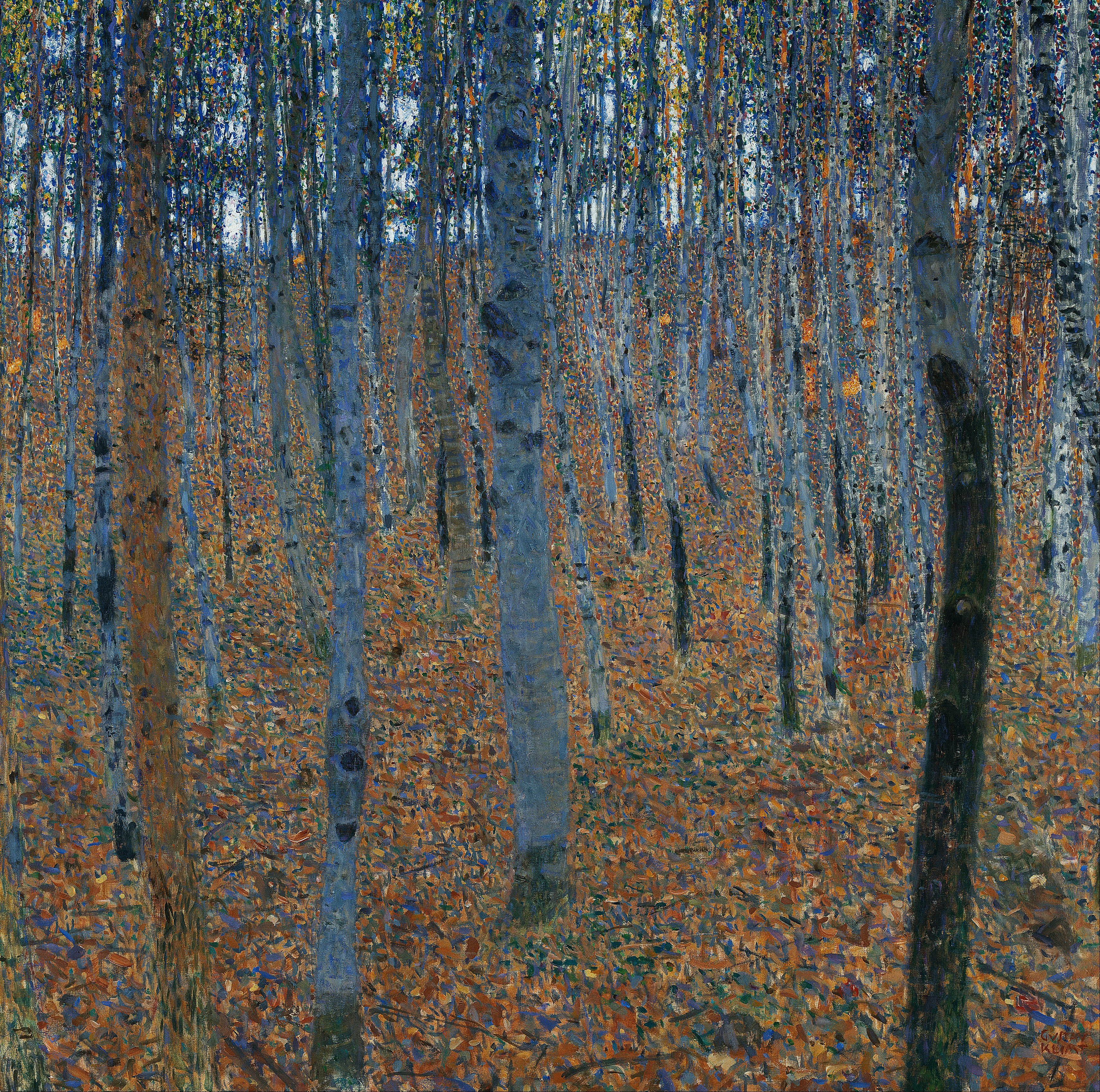
A grove of trees by Gustav Klimt, Wikimedia Commons

But with the crucial need to increase tree cover, how we imagine forests, and portray them in art, becomes more important. We can see them positively – as places bristling with life. Arnold Bax’s tone poem The Happy Forest sets out as a jolly, scampering scherzo full of contrast and colour, while a translucently beautiful slow theme at its heart suggests that this sylvan paradise is fragile.

Sibelius’s Tapiola, on the other hand, is much more unsettling. It is named after Tapio, the wood God of Finnish myth from The Kalevala. As the composer introduced it:

Widespread they stand, the Northland’s dusky forests,
Ancient, mysterious, brooding savage dreams;
Within them dwells the Forest’s mighty God,
And wood-sprites in the gloom weave magic secrets.

The music of this austere, icy work seems to emerge organically out of its terse opening statement. With pregnant silences and near-silent whispers, much of it suggests an eerie stillness; at other times its forces coalesce into a kind of horrible majesty. In one remarkable passage, string tremolos run up and down furiously and all sense of tonality dissolves. We are briefly lost in a nightmare panic.

Bax and Sibelius both responded imaginatively to the idea of forests. But composer Judith Weir describes how, in one of her projects, the theme seemed to choose her:

I started to write this piece with nothing but the opening melody in mind. As I arranged this apparently simple material for an initial ensemble of four solo violas and cello, the intertwining lines seemed to be sprouting musical leaves; or, in other words, interesting melodic and harmonic fragments were being generated almost as if in a process of nature.

She called the resulting work Forest, and its self-perpetuating counterpoint suggests a benign place, blossoming with colour and geometric fascination. It is less an object on which to project human feelings as a form which is growing and interacting with itself, and which we could imagine developing indefinitely after the final bars have ended.

It seems to me that this understanding of forest as a dynamic process is the most crucial to our current moment. We know that trees are more than shading street decoration, and forests are more than places to admire on a hike through a national park. They are a part of the planetary system in which live and on which we will depend.

What’s more, trees are not nearly so still as they appear. As a recent New Yorker piece explained, they respond to their environment all the time – through the stimuli of night and day, sunlight and rain – with changes imperceptible to the naked eye.

It’s awful to watch in despair as vast tracts of the world burn. But there is much we can do, through political pressure and consumer choices, to resist the forces that drive deforestation around the world (cutting back on beef is a good place to start). And as the debate continues about where and how to increase tree cover, perhaps one part of our response should be to pay more attention to these gentle giants, which have so much to tell us about the interconnected world we live in, if we learn how to read them.

Here in Britain at least there is one small piece of good news: this month the Forestry Commission is celebrating its 100th birthday. To mark the occasion, and to recognise the importance of forests in arts and culture, they have commissioned a new work by the poet Tiffany Francis-Baker.

Reading about the centenary, it surprised me to learn that since the organisation’s founding, England’s forest cover has doubled. A moment, then, to recognise that progress can be made. But not for forgetting how far there still is to go.

My blogs are powered by caffeine. So if you enjoyed this one, a cheap but meaningful way to support my writing is to buy me a coffee on PayPal.

Dance: Jason Vieaux, Escher Quintet

The sun is out, the temperature is climbing into the 30s, and a new disc from guitarist Jason Vieaux and Escher Quartet is a perfect summery discovery. Released on the Azica label, it’s called Dance.

The (rather long) name of Mario Castelnuovo-Tedesco (1895-1968) was a new one to me – but the opening guitar quintet by this Italian composer is an absolute delight. Warm and witty, with plenty of rhythmic vigour and harmonic sweetness, it is precisely the right injection of Mediterranean sunshine to go with the balmy weather. The mellow timbre of guitar fits in with bright strings surprisingly well. What a find this composer is – and, I might reflect, how under-rated the guitar repertoire is.

Contrasting this wonderful work is something newer and something older. Aaron Jay Kernis’ 1993 piece 100 Greatest Dance Hits is a reflection on 90s pop music styles, although he confessed that while composing it ‘the sounds of 70s music rose to the surface most strongly’. Despite the name it is only 4 movements long – a fun novelty, and it even ends with a bit of beatboxing.

The disc then takes us back to Mediterranean heat, only that of the 18th century. If the genteel mannerisms of Boccherini’s ‘Fandango’ quintet  sound a bit staid in comparison to what came before, then it certainly demonstrates the length of the tradition in writing for this combination of strings. The titular dance of the finale reveals the Spanish influences of the Italian composer’s settled home – furiously alternating between two chords, and building to a climax with castanets for a rousing finish. 

All in all Dance is a charming musical package holiday, even if the British heatwave barely warrants it. Explore your listening options here.

Sussex By The Sea

The old windmill on Beacon Hill, Rottingdean.

holsthousezoom     Simon Brackenborough

All villages have stories to tell. Many are mere provincial tales; some might contain a passing connection to a figure of wider renown.

But there are a few villages which are blessed with unusual distinction. One of these is nestled in a dry valley running down to the Sussex coast, in the Downs to the east of Brighton.

While the buildings of its seafront are unremarkable, to walk to the centre of Rottingdean is almost like stepping into a children’s picture-book of rural England. There’s a pond, a green, an old church, a variety of characterful houses and beach-pebble walls, all overlooked by black windmill on a nearby hill.

I recently spent some time cat-sitting for a relative here, and learned a little of its history. There are a few stories of smuggling, hardly uncommon on this coastline. In 1377, the village was even attacked by French raiders.

But most surprising to learn was how, in the last two decades of the nineteenth century, a series of extraordinary cultural figures passed through this place – spanning politics, visual art, literature and music.

North End House, now knocked together from separate properties.

On the west side of the green is a house with a plaque honouring the artist Edward Burne-Jones. Today he is best known for his paintings in a Pre-Raphaelite style and the stained glass designs he made for the firm of William Morris.

In the early 1880s Burne-Jones was living in London with his family when this house became their country retreat. His wife Georgiana described encountering Rottingdean one ‘perfect autumn afternoon’:

The little place lay peacefully within its grey garden walls, the sails of the windmill were turning slowly in the sun […] The road I followed led me straight to the door of a house that stood empty on the village green and we bought it at once.

The idealised aesthetic of the Pre-Raphaelites drew on Medieval art and literature, and for an artist with these sensibilities it is easy to see how a pretty rural village would have appealed as a getaway from Victorian London.

St Margaret’s Church and its walled gardens.

Across the green from their house, several Burne-Jones windows can be seen in St. Margaret’s church, including a depiction of St. Margaret to mark the marriage of his daughter of the same name. Among other projects he worked on in Rottingdean was a private ‘flower book’, with roundel illustrations based on the common names of flowers.

But Rottingdean turned out not to be quite the perfect pastoral idyll. As Derek Heater has described in his village history, Burne-Jones complained about noise, and opposed the introduction of electricity. The village also became the terminus for an extraordinary seashore electric railway running from Brighton through the shallow waters, and when this enterprising leisure venture was damaged in a storm, he admitted to ‘rather spiteful rejoicing’.

The Seashore Electric Railway, or ‘Daddy Long-Legs’, Wikimedia Commons.

Metropolitan types securing a second home in the country, only to find it doesn’t exist to serve their fantasy of rural life? Some things never change.

In 1889 the Burne-Joneses bought the neighbouring Aubrey Cottage, knocked it through into one property and renamed it North End House. It’s a rather grand sight, but further down the high street stands a building that’s become considerably more neglected.

The former St. Aubyn’s School.

Closed since 2013, this used to be St. Aubyn’s School. Back in the 1880s it was known as Field House, and it was here, while the Burne-Joneses were staying a minute’s walk away, that a young Ralph Vaughan Williams was educated from the age of 11 to 14.

His widow Ursula’s biography paints a picture of a happy time here, and Vaughan Williams benefitted from excellent music tuition. He learned some of Bach’s easier piano pieces, and performed the violin in school concerts. On a trip to Brighton he was wowed to hear Hans Richter conduct Wagner’s prelude from Lohengrin and The Ride Of The Valkyries.

These were formative years for his musical awakening, but Field House also gave Vaughan Williams a fondness of the Sussex landscape. ‘The great bare hills impressed me by their grandeur’, he said. ‘I have loved the Downs ever since’.

If some villages attract people of unusual distinction, in Rottingdean’s case that is partly because some families do the same. Georgiana Burne-Jones was born a MacDonald, and was one of several sisters who made remarkable marriages that would leave their mark here.

Georgiana, painted by Edward, with their children Philip and Margaret in the background. Wikimedia Commons.

Agnes MacDonald married the architect Ambrose Poynter; their son Edward was a respected painter. Louisa MacDonald wed businessman Alfred Baldwin, and their son Stanley Baldwin would go on to be Prime Minister three times. As a young man visiting Rottingdean, Stanley met Lucy Ridsdale, whose family owned the large house The Dene, and in 1892 they were married in St. Margaret’s. 

Meanwhile, Alice MacDonald had married the artist John Lockwood Kipling, and moved with him to India. Their son, Rudyard Kipling, stayed in Rottingdean as a teenager. In 1897, the now thirty-one-year-old had made a name for himself as a writer when he decided to rent a house here called The Elms, with wife Carrie and two daughters in tow.

The village pond.

It must have seemed auspicious that soon after their arrival in Rottingdean, their son John was born. Sadly however, Edward Burne-Jones died the following year, but there were still happy times with extended family staying around the village.

‘One could throw a cricket ball between any one house to the other’, Kipling wrote of their various dwellings, and the young Baldwin and Kipling offspring would be bundled into farm-carts and taken by horse up into the Downs for ‘jam-smeared picnics.’

Such was the magic of the place that Kipling was inspired to write the poem Sussex. It concludes:

God gives all men all earth to love,
But since man’s heart is small,
Ordains for each one spot shall prove
Beloved over all.
Each to his choice, and I rejoice
The lot has fallen to me
In a fair ground—in a fair ground—
Yea, Sussex by the sea! 

But Kipling tended to spend the winters abroad, and as a writer of Empire, his works of the Rottingdean years have a considerably less cute side. For Queen Victoria’s 1897 Jubilee he composed Recessional, which seemed to foretell the British Empire’s decline. Soon after, The White Man’s Burden became one of his most controversial poems, revealing the racism that underpinned Western conquests with the lines ‘Your new-caught, sullen peoples / Half-devil and half-child’.

America was the new rising power, and Kipling sent The White Man’s Burden to Theodore Roosevelt with a message encouraging the American invasion of the Philippines. During the Boer War, he wrote The Absent Minded-Beggar to help raise funds for troops, which was set to music by Arthur Sullivan.

His imperialism put him at loggerheads with the widowed Georgiana, who was an idealistic socialist. She busied herself on Rottingdean’s parish council, trying to improve the lot of ordinary village folk, though it seems her good intentions sometimes struggled to bridge the social gap between them. After the Boer War, she hung a banner proclaiming ‘We have killed and also taken possession’, which brought about an angry crowd, requiring Kipling to play the unlikely peace-maker.

Life became immensely more difficult for the Kiplings after the tragic death of their daughter Josephine in 1899. And with Rudyard’s reputation growing quickly in this period, he resented being gawped at by day-trippers as a local celebrity. In 1902, the family left the village.

By this time, Vaughan Williams was a young man on his way to becoming a leading proponent of the English folk-song revival, both as a song collector and composer. And yet amazingly, he is not even Rottingdean’s most famous connection to this cultural movement, which gathered pace as the new century dawned.

Challoners Cottages.

On a row of cottages towards the north end of the village is another plaque, commemorating the former residence of the Copper family. Their connection to Rottingdean goes back to the sixteenth century, and they were known locally for their songs, sung in harmony.

And so it was that in November 1898 – the same month that Kipling was writing to Roosevelt – the musician and folk-song collector Kate Lee came down to notate songs from James ‘Brasser’ Copper and Tom Copper, a farm foreman and pub landlord respectively.

They met at the house of another local big-wig, Edward Carson QC, who had worked on the scandalous Oscar Wilde trials three years earlier. If Georgiana’s civic activism had struggled to cross Rottingdean’s class divisions, this musical meeting seems to have been more successful. As Lee later described it, ‘I shall never forget the delight of hearing the two Mr. Coppers’:

They were so proud of their Sussex songs, and sang them with an enthusiasm grand to hear […] You only had to start either of them on the subject of the song and they commenced at once. ‘Oh, Mr. Copper, can you sing me a love song, a sea song, or a plough song?’ It did not matter what it was, they looked at each other significantly, and with perfectly grave faces off they would go.

It would be her most important collection. Not long after, Lee became founding member of the Folk-Song Society, which was later merged into the English Folk Dance And Song Society. In the 1950s, the BBC re-discovered the Copper family and broadcast their songs to a wide audience. The descendants of ‘Brasser’ and Tom still sing today, and have toured internationally.

Rottingdean has had a fair few other distinguished residents – I won’t even try to provide and exhaustive list, but North End House was later the home of Reuters chairman Sir Roderick Jones and writer Enid Bagnold. 

The Undercliff Walk.

Sadly, the bizarre seashore railway only lasted a few years, but in the 1930s an ‘Undercliff Walk’ was constructed along the coast which is still in use today, and makes for a spectacular trip. During my stay, I enjoyed daily bicycle rides into Brighton along here, alternatively aided and hindered at the whim of the sea breeze. 

There’s no doubt that Rottingdean is almost sickeningly pretty. Its desirability as a place to live is only increased by the kind of independent shops and cafes that could make many large towns green with envy. It even has its own museum! How lucky a village can be, through the strange alignment of geography and history.

Nonetheless, posters around the community speak of normal mundane pressures: court decisions about controversial developments, the need to reduce traffic congestion. Edward Burne-Jones surely would have balked to see the busses barely scraping along its narrow old high street.

The Kipling Gardens.

But today, in the heart of the village, you can find one of its top attractions. The former grounds next to The Elms were bought by the Rottingdean Preservation Society, and are now open to the public as the Kipling Gardens.

Walking through its walls on a summer’s day, with its flowers in bloom and the windmill gazing down, you can see the old imperialist was right about one thing. There is something very special about this ‘lot of fair ground’ in Sussex by the sea.

My blogs are powered by caffeine. So if you enjoyed this one, a cheap but meaningful way to support my writing is to buy me a coffee on PayPal.

Songs Without Words

Sadly, there aren’t many youth discounts I can claim with any honesty these days. But I recently found myself just the right side of 35 to buy a cheeky £5 ticket to the Wigmore Hall. What this generously high threshold says about the demographics of their audiences I can only guess, but I was pleased, as it had been a regrettably long time since I’ve pulled up a pew in that hallowed chapel to chamber music. 

I was acting on a recommendation to hear the rarely-performed Richafort Requiem, along with some Josquin, sung by the Austria-based vocal ensemble Cinquecento. 

Perhaps this was a little too much Renaissance music for a Friday evening, because the hall was only patchily filled. I was even able to bag a seat near the front at the last minute – one I’ll have to shell out £40 for in six month’s time. 

More’s the pity – because the singing of this rather sober-looking choir was exquisite. The Richafort, with its rich six-part harmonies, was the stand-out work of the evening. 

And yet, for all this, something was missing.

It reminded me of another concert a few months ago. In Newbury, a local choir put together a programme celebrating ‘friendship’ between countries across Europe, as represented by their various composers. In the run-up to the original Brexit date of 29th March, I was amused by the undisguised political point being made. It also had a good mix of music I liked and music I was interested to hear, so I went along.

Perhaps I should have noticed something wasn’t right from the works list. You’d expect the theme of ‘friendship’ to bring out positive sentiments – maybe a saucy madrigal about women and wine, or something stirringly idealistic. Not so much. This choir, conducted by a former member of The Sixteen, went in heavy with the cloistered religious vibes. 

If this was the music of friendship, I thought, why was it on its knees in a cassock? Cornysh’s Woefully Arrayed was a case in point. A wonderful work in its own gothic way – and its title all too accurate about the state of UK politics right now – but it’s fair to say it won’t be replacing Ode To Joy as the EU anthem any time soon.

Still, at both Wigmore and in Newbury, the churchy bent of the repertoire wasn’t my main problem. At both I paid for my ticket, turned up and heard a good performance – to the choirs’ respective standards. The problem was a certain lack of warmth. There was nothing from the stage to make me feel welcome as part of either event. At both, the musicians…the musicians just didn’t say anything at all. 

Is that weird? Because I kinda think that’s weird.

Seriously: in what other genre of music could someone conduct a concert celebrating ‘friendship’ and give no verbal greeting to the audience whatsoever? No introduction to the pieces and why they were chosen, no ‘thank you for coming’ at the end? It gave the whole evening an absurdist tinge – and yet, sadly, I wasn’t even that surprised. 

This is a tendency I’ve seen too often – to treat classical music as something self-contained, divorced from any social context, and needing only a good performance to speak for itself. It seems to assume that the audience will be clued-up and engaged enough to enjoy it without recognition being made to them as fellow human beings, investing their time and money in an evening out.

Since the Wigmore recital, I’ve been thinking about this more. At an orchestral concert, it’s nice when a conductor makes an effort to introduce the programme, but it rarely feels like such a problem when they don’t – occasionally, when one decides to test out their alternative career as a comedian, silence seems like a blessing. And at an opera, you wouldn’t want to break the fourth wall before it’s begun.

I think the question is about the scale of the space and the music. In the same way that big cities are less friendly than small villages, in a more intimate recital it feels like a greater courtesy is owed to the audience. With a capella vocal music, that natural intimacy feels greater still. And intimacy without niceties is a strangely transactional affair, one that never fully satisfies.

Of course, in the case of international touring musicians like Cinquecento there is also the issue of language. We shouldn’t assume everyone can speak English, and with confidence –  although my experience of trying to speak German in Vienna and having good English spoken back to me makes me doubt it was an issue in this particular case.

And none of this is to underestimate how terrifying public speaking can be, on top of the stresses of musical performance. I don’t suppose it’s easy for most, and there’s surely an art to doing it really well. But, as shown by the strangely penitential repertoire in Newbury, there is a value in making it clear to an audience why the particular music has been chosen, and what it means to you.

So many musicians get this right. A few hours before the Wigmore concert, I went to a lunchtime recital by a young lutenist in St. Bride’s Church. He was evidently a shy man who preferred to let his fingers do the talking. But even he managed a few mumbled words about the pieces. It got me interested in what he was about to play. It made a difference.

I think that perhaps we don’t talk enough about how antisocial classical concerts are. To sit in silence is isolating. It’s the before, after and in-between where any social aspect comes into play – assuming you’re attending with friends. And if you’re the kind of sad loser like me who goes to the Wigmore on a Friday night on his own, an indifferent presentational style is especially disappointing. However good the music is, it ends up emphasising the loneliness of the experience.

Who were these singers, in relatable human terms? What did it mean for them to be performing the Richafort Requiem, or a selection of European pieces in the run-up to Brexit? I still don’t know – they couldn’t or wouldn’t say. The saddest thing of all is what it made me ask myself, as we filed out none the wiser: why am I doing this? 

Malcolm Arnold said that music is ‘a gesture of friendship, the strongest there is’. Like many great quotes, it’s a fine sentiment with some truth to it, but it brushes aside the caveats. At both concerts, I paid for a ticket and made a journey, only to leave feeling to some extent unacknowledged. What impression would this kind of silent treatment make to somebody attending live classical music for the first time?

I’m not a performing musician, and I’ve never studied at a conservatoire. So I’d be interested to know how much, if at all, such aspects of performance practice are discussed and taught at the highest level. If you have experience of this, I’d love to hear your views. Because intimacy without niceties will always feel weird to me.

‘Trans’ by Kaija Saariaho

Truth be told, I’ve always been more of a symphony man than a concerto man. That’s because I often find the concerto’s traditional element of conspicuous virtuosity – the need to parade what a master soloist can do – a little vulgar and off-putting.

But this is no concern with Trans, a harp concerto featured on a new disc of orchestral music by the Finnish composer Kaija Saariaho. Her compatriot Hannu Lintu conducts the Finnish Radio Symphony Orchestra, while harpist Xavier de Maistre takes the solo part that was composed for him in 2015.

It’s not that his role is in any way simple, of course, but as Saariaho is quoted in the liner notes: ‘for me, a concerto is less about traditional virtuoso technique than about drilling deep into the soul of the instrument’. And the result is about as subtle a concerto as you’re likely to hear.

Of course, harps are rarely put on a pedestal in this way, and for good reason – the instrument is quiet, and difficult to bring out over a full orchestra. But Saariaho makes this limitation into a feature, by putting it into dialogue with smaller instrumental groups (a crossing-over alluded to in the title) but which rarely reaches anything like a loud volume.

With Saariaho’s feeling for atmospheric scoring, Trans becomes a kind of antithesis of the extrovert concerto – it is quiet, reflective, mysterious. I found it an immediately fascinating listen. Harp and orchestra alike spend a lot of time exploring short repeating motifs and intervals, like bubbles up rising to the surface of a lake – if that’s not too much of a Finnish cliché.  

The titles (in French, as is often to be the case with her music) spell out poetic approaches to instrument – Fugitif, Vanité, Messager. The middle of these, referring to the ‘Vanitas’ genre of still life painting, certainly does justice to her careful, painterly touch with the orchestra. 

A set of six songs called True Fire leads the album, setting some remarkably eclectic texts and sung here by the baritone Gerald Finley in a live performance. There’s also Ciel d’Hiver (Winter Sky), a smaller rescoring of a movement from her orchestral triptych Orion. But it is Trans that really caught my ear in this record.

Listen to this disc on Spotify, iTunes, or visit the Odine website. Read an interview with Saariaho about composing the concerto, or examine her orchestral wizardry in all its fine detail by browsing the score here

Susanna Fair

Susanna And The Elders by Jusepe de Ribera, Wikimedia Commons.

holsthousezoom     Simon Brackenborough

In Shakespeare’s Twelfth Night, Sir Toby Belch is up late drinking with Sir Andrew Aguecheek. With drunken merriment, he sings a short strain: ‘There dwelt a man in Babylon, lady lady!

These words refer to a popular ballad of the time, which tells the Biblical story of Susanna and the Elders. Originating in the Apocrypha of the Book of Daniel, its theme of the sexual coercion of a young woman by older men remains all too resonant today.

The song’s Babylonian is the wealthy Joachim, but his beautiful young wife Susanna is at the heart of the story. Two elders find her bathing alone in her husband’s garden. They threaten her that if she will not lie with them, they will accuse her of adultery, and – their word naturally trumping hers – she will be put to death.

Susanna is dismayed, but out of respect for God she refuses to acquiesce. And so she is accused. But by divine intervention, the young prophet Daniel exposes the false witness of the two men, and they are executed instead, while Susanna is saved.

The full ballad tells this story with a pleasingly grave, stately tune – I like the following arrangement in particular.

Various other composers have been drawn to this tale. Handel – being Handel – made it into a three-hour oratorio, but the music that first introduced me to the story lasts a mere three minutes.

William Byrd’s Susanna Fair is a consort song for voice and viols. Its two verses present a simple moral binary, contrasting the threat of the elders and Susanna’s refusal. The first verse begins:

Susanna fair some time assaulted was
by two old men, desiring their delight,
which lewd intent they thought to bring to pass,
if not by tender love, by force and might

Byrd squeezes a huge amount of craft into this small song, with intricate counterpoint shifting ever restlessly. It starts with a short, furtive motif, passed around the viols like a malicious rumour. When the voice joins in, the words ‘two old men’ are underlined by a change to stark chords, before melting into a syncopated major-key cadence for ‘desiring their delight’.

This sudden sunny turn is perhaps the song’s loveliest moment, so there is poetic irony that the words here refer to the men’s malicious motive. Byrd’s music side-steps from minor to major, much as the text’s euphemism of ‘their delight’ tiptoes around the brutality of the act.

But this dramatic shift also emphasises the opposing intentions of the characters. In the second verse it coincides with Susanna’s response of steadfast piety: ‘my chastity shall then deflowered be’. While the elders prize the fulfilment of their lust, she only thinks of preserving her virtue.

Musically speaking, Susanna Fair is an exquisite little gem. But the tale’s morality remains thoroughly patriarchal. It is not to her own bodily autonomy that Susanna defers, but the authority of the ultimate Father – God. At the end she explains that she would rather ‘die of mine accord / ten thousand times, than once offend our Lord’.

You could say that Western art history has not exactly shown reticence towards female nudity, so it’s no surprise that the scene of Susanna bathing has been painted countless times. It can even be found engraved on a Carolingian crystal.

For many artists, the drama of the attempted coercion proved irresistible. Susanna is often shown hurriedly covering up – rarely with total success, it seems – while the elders deliver their ultimatum. In other depictions, they physically grapple with her.

But a very different example hangs in London’s National Gallery. Francesco Hayez’s 1850 painting shows Susanna alone, glancing over her shoulder at the viewer. Now we have become the voyeurs. Having seen it ‘in the flesh’, I’ve always interpreted this coy figure – her posture relatively relaxed, a leg crossed towards us – as deliberately alluring.

Francesco Hayez, Susanna Bathing, Wikimedia Commons.

Is Hayez sympathising with the lust of the elders here? Or is it that, by positioning us in this way, he is making a point about the art world’s obsession with female nudity? 

For all the great male artists who have painted Susanna, surely no one has brought as much personal experience to this story as Artemisia Gentileschi. While still a teenager in 17th-century Rome, she was raped by fellow artist Agostino Tassi – incredibly, during the resulting trial she was tortured to test her allegation, while he eventually walked free.

Several paintings of Susanna are attributed to Gentileschi. One, seemingly made when she was just seventeen, shows Susanna shrinking away in anger and disgust while the conspiring elders encroach on her from above.

Susanna And The Elders by Gentileschi, Wikimedia Commons.

Other pictures, such as her remarkably violent Judith Slaying Holofernes, have drawn interpretations of personal revenge fantasies for the traumas she endured – though how much the lurid tastes of patrons played a role here is still debated.

The Old Testament is hardly the first place you’d look for enlightened sexual politics. But Gentileschi’s harrowing life story – and her amazing art – is a powerful testament to the grim reality of sexual violence, in a world without justice through divine intervention.

Not for nothing does the old English ballad introduce Joachim and his reputation first. For all the beauty and drama of artworks inspired by Susanna, they still speak powerfully of a world that would rather see a woman die ‘ten thousand times’ than let her once have control of her own body and destiny.

My blogs are powered by caffeine. So if you enjoyed this one, a cheap but meaningful way to support my writing is to buy me a coffee on PayPal.

Notes On A Fantasy

An illustration from ‘Elfin Song’ by Florence Susan Harrison, shared by Plum Leaves on Flickr, Creative Commons.

holsthousezoom     Simon Brackenborough

Fantasy sells. Game Of Thrones and Harry Potter are testament enough to that. But while wizards and dragons are familiar in fiction, fantasy has a long history in instrumental music too.

There’s the ‘fantasia’ form, whose lack of constraints begs the composer to indulge their imagination. Works like Berlioz’s Symphonie Fantastique have used the orchestra to tell a specific fantastical story.

We might expect the music of fantasy to be dazzling, exciting, dramatic. Otherwise, what would be the point? This impulse could manifest itself in a number of ways, but here I want to share one of my favourite examples: the Fantastic Scherzo by the Czech composer Josef Suk.

Josef Suk, Wikimedia Commons.

Scherzo means ‘joke’ – and is commonly used for fast, boisterous movements of a larger work, usually relatively short in length. But Suk’s free-standing movement, running at about 15 minutes, is effectively a full-blown tone poem. Smetana’s Vltava or Saint-Saëns’s Danse Macabre are perhaps good comparison pieces – and like these, this has an unforgettable, sweeping melody at its heart.

Suk begins in a suitably rambunctious fashion, with a tussle of insistent melodic fragments and stabbing interruptions. The bright timbres of woodwind, brass and triangle feature prominently.

But an unexpected sleight of hand soon sends us tumbling down a rabbit hole. The lower strings and bassoons make a snaking descent, and suddenly we find ourselves in another world entirely. A waltz begins on the cellos, smoothly gliding and gracefully shaped, with an irresistible sway.

And what a joyful melody it is. See how it twice sets itself a problem – a long drop of a seventh – and climbs its way back up the scale. At the second instance it ecstatically spills over, and flourishes into a dancing rhythm as it descends.

Suk’s cello melody.

Illuminated by woodwind figures, shining violin harmonies and tambourine rhythms, it’s pure magic. But the spell is soon broken, and the music picks up the muscular battle once more.

These two musical worlds alternate throughout the outer sections of the piece. But while the fragmentary elements are constantly developed and churned about, this melodic episode is always preserved pristine. It seems incorruptible – it could be a dance of eternal youth in a fairy kingdom.

Suk understood that fantasy is about transporting us. And alongside the ‘hidden portal’ trope of the rabbit hole or Narnia wardrobe, authors such as Tolkien have also imagined arduous journeys to distant lands.

The transition to the central section of this work creates a similar feeling of remoteness. A bridging passage with a series of unpredictable harmonic shifts, dramatised with cymbal strokes, takes us over the hills and far away.

We arrive at a picturesque scene: trilling woodwinds overlap like forest bird calls, and gentle harp chords echo with mythic suggestions. A mournful song emerges on the cellos. Suk is combining his fragmentary and melodic approaches now, to tell a new story. And this languid river of sound soon builds in strength to reveal a mountainous grandeur.

After an equally strange transition on quiet, divided cellos, the thrilling energy of the scherzo erupts anew – and while the alluring dance melody is given its due, it’s this blistering spirit that claims victory in the end.

Fantasy sells – but it relies on us being able to suspend our disbelief. Without that, the genre can seem twee, ridiculous and far-fetched – just as a musical fantasia might sound wayward and unconvincing in the wrong hands. But on this count, I think Suk’s scherzo – jesting and joyful, wild and winsome as it is – succeeds magnificently.

My blogs are powered by caffeine. So if you enjoyed this one, a cheap but meaningful way to support my writing is to buy me a coffee on PayPal.